A diet of 30 plants that humans consume is less worrisome that Michael Pollan's argument.
As mentioned in my post on re-wilding yourself with wild edibles, Michael Pollan has much to discuss on this subject. Pollan in In Defense of Food, says that the majority of American's calories come from 4 foods: wheat, sugar, soy, and corn. However he also mentions that another big portion of the calories come from dairy and meat products as you can see in the pie chart below from Food is Medicine.
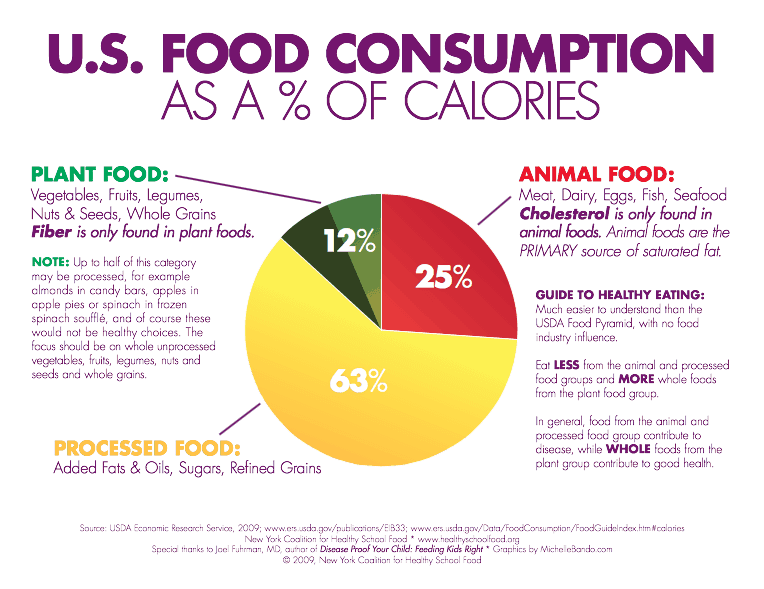 Many health gurus tell you to eat simple, and this makes intuitively like eating an apple. I consider my diet simple as far as eating a large variety of fruits, vegetables, greens, grains, beans, nuts, seeds, but this means that I'm get a variety of vitamins and minerals. The kind of simplification in the typical American's diet is excluding these health foods for diet that is simplified to a handful of the same ingredients for every meal with a different arrangement of those ingredients.
Let me be clear: I do not fault an individual for the availability and price of unhealthy processed foods. Actually, there is much to say about the way food is distributed such as grocery gaps where urban and rural areas have to travel up to 20-50 miles to get a grocery store. Considering this, there are family dollar stores, gas stations, and liquor stores in close proximity to the poor urban and rural regions of this country. I can protest all day to avoid putting your dollar in these big corporations that are making you and your family unhealthy. And let me also be clear: just because your skinny, doesn't mean your healthy; and just because you're fat, doesn't mean your unhealthy.
In considering all of this, who do we look to that created this unhealthy industry? Do the CEOs and head management eat the crap that they sell in stores? Does Doritoes eat Doritoes? Do these people that run the corporations let their children sit in front of the TV and watch the food ads they put on TV to brainwash children?
It's similar, but not quite the same way cigarettes are sold. There is a warning label on cigarettes, but the only labels on packaged foods are those that are deceiving you into thinking it's a health food. Healthy food is a whole food like fresh fruits and vegetables.
The limited ingredients in a diet is just the least of our worries, because a much more pressing issue is that 40% of U.S. food is wasted, equating to $165 billion a year in waste according to CNN. This means that there IS enough food to feed the world, and the problem isn't an expanding population where the globe cannot produce enough food for everyone. This is another problem with corporations: they're producing too much food, and distributing too much food in the most consumer-heavy regions. Of course packaged food has a "long shelf life", which basically mean there isn't any nutrition left. So, let's consider what food is wasted the most. I worry, though, that when people do attempt to eat fruits and vegetables, this food typically goes to waste.
As mentioned, packaged food that can be preserved with a longer shelf life than fresh, raw fruits and vegetables, is a mixture of those same ingredients of meat, dairy, wheat, corn, soy, and sugar. Because these foods are highly processed, thus their raw, fresh form loses the nutrients and minerals that once was there before the processing. The solution to unhealthy food consumption and food waste isn't to grow more, sell more, or donate more. The solution lies within the power structure. This may sound like a radical idea, but by giving people and families their own land to grow their own food will be part of the solution.
This further angers me because there is the safety of pesticides and GMO foods argument that we need these technological innovations to ensure we have enough food and no money is wasted--well, isn't that a laugh when we consider that people deliberately are wasting food, and corporations continue to over produce and over sell foods. Not only is food wasted and chemicals used becomes unnecessary, but fuel and transportation become wasted. And lets get real about the land we use for what: where we have hundreds of acres of wheat, corn, and soy being grown exclusively for the fattening of cows, chickens, pigs, and animals to get fat on their unnatural diet in order for humans to consume them.
Of course there are many solutions, but we cannot keep making the same mistake of selling and growing more, because the problem is where the food is getting distributed, as mentioned by National Geographic: "the richer the nation, the higher its per capita rate of waste." National Geographic also states that: "To compound the environmental insult, food buried in the airless confines of dumps generates methane, a greenhouse gas far more potent than carbon dioxide. If global food waste were a country, it would be the third largest generator of greenhouse gases in the world behind China and the United States."
Restaurant buffets are notorious for food waste. In fact the other day as I watched my mother and sister eat at a Chinese restaurant, we examined a family that continued to get food from the buffet that they ended up leaving there to be thrown away. My mother, sister, and I were furious at this, to the point we wanted to take the food (because we watched, and the food wasn't touched).
Additionally, we have to refuse a global food corporation like McDonalds taking over America, India, Asia, and Africa. We got to refine the food market, but the food shall not be refined!
The solution is not necessarily individuals taking their business elsewhere, it is a matter of a culture shift and changing our perspective about the kinds of food we want to sustain the planet that works with this planet.

