Showing posts with label starter plants. Show all posts

Friday, March 9, 2018

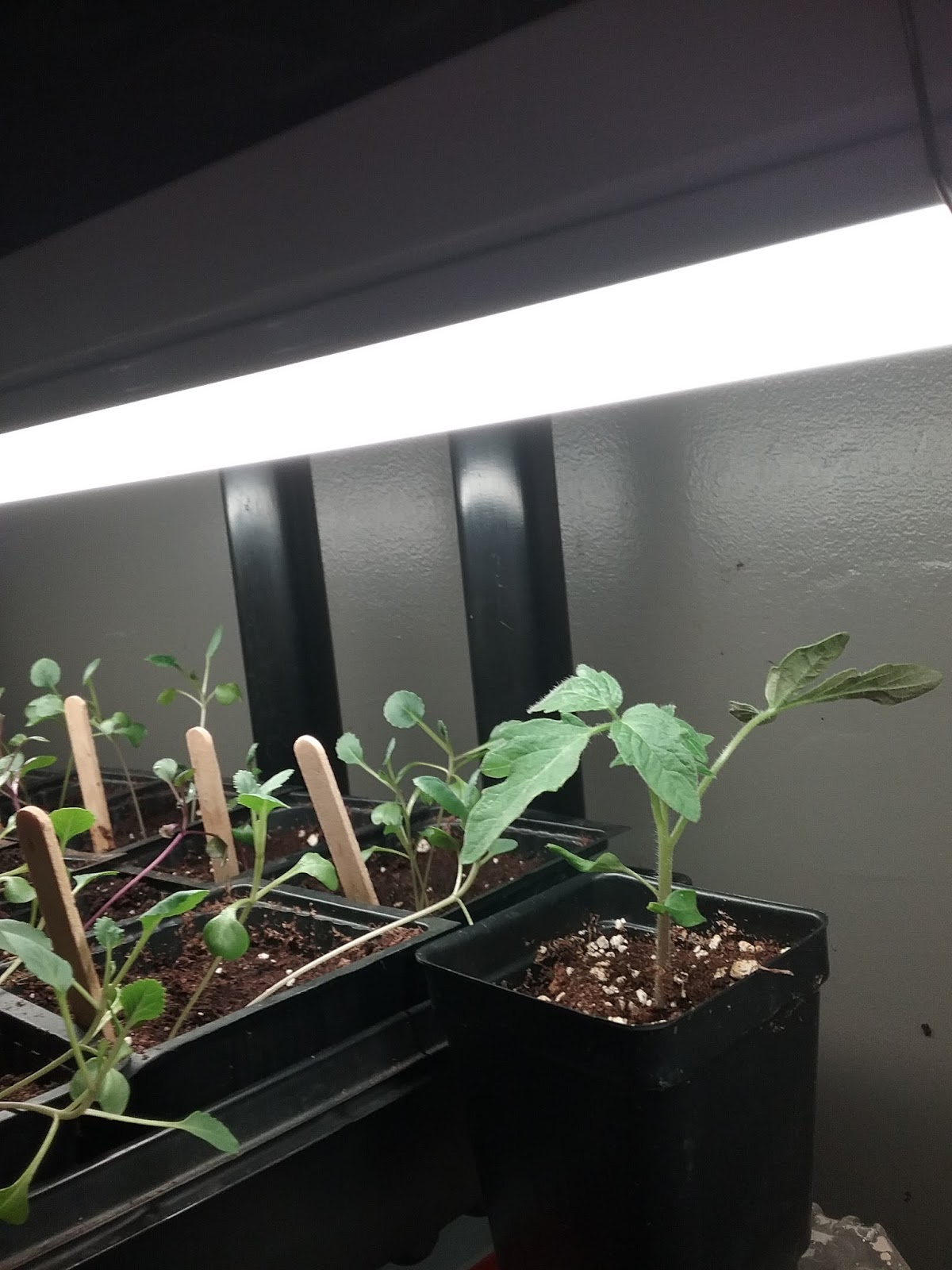
Early March starter plants under grow lights

The starter plants are a couple weeks old. I have been keeping them under a grow light in my kitchen. On the warm days, I take the starters out to the porch greenhouse and then back in at night. These are cauliflower, varieties of cabbage, and collards. I used potting soil mixed with seed starting mix for the starters and keep lights on the plants for over 10 hours. The amount of light varies depending on when I wake up and go to bed because I don't have the lights on a timer.


As I was passing the greenhouse center where I usually get truckloads of mulch, I bought three Early Girl Tomatoes and put them with the starters. I also have cilantro, basil, onions, and carrots growing as well.


Soon I will sew other tomato varieties indoors in recycled water bottles because they're bigger containers than typical starter cells and pots. I tend to start tomatoes and peppers indoors early in March, but I end up regretting starting early because they'll grow better, faster, stronger if I threw out a bunch of seed in the summer instead.

Come April, I'll have greens transplanted outside in the garden and I'll have summer crops started indoors. Tuesday I sewed lettuce varieties indoors along with radish, swiss chard, broccoli, so we'll see their progress in a month, and I'll transplant them outside with the cabbage and cauliflower.

Tuesday, February 13, 2018

Starting veggies indoors & making rock gardens

Last week I started cabbages, cauliflower, collards, and red lettuce. Once they sprouted, I have kept them in the greenhouse during the day, then I bring them in at night with a light on them for a couple of hours. I used a seed starting mix for these plants, then I will transplant them in one of my gardens in March.


Come March, hopefully I'll have much of my main garden mulched so i can directly sew early growing peas, radishes, and lettuces. By this time, many of the early flowering plants will be up, as I already see the daffodils, hyacinths, and tulips poking through the soil. The crocuses of course are blooming since they're a very early blooming flower.


In a couple of days, I'm going to start onion and carrots indoors as well with a tray filled with potting soil. Once they get established, I'll put them out in April.

In my last post, I forgot to show you the rock gardens by placing rock around fruit trees and fruit bushes. I have been collecting rock from the woods and hauling them to the garden with a wheel barrow. In addition I have been placing rock over paths in the garden because the paths are getting swampy as this winter has been very wet.


Rocks around 4 of the peach and nectarine trees


Rocks around 10 of the blueberry plants & goji berries

Wednesday, March 15, 2017

Indoor grow light tomato garden + tropical houseplant update

On the 7th of February I started tomatoes indoors. This is very early to start tomatoes for my Zone 6-7 in Kentucky. But I wanted to start them early because I wanted to do additional experimenting with the grow lights and creating the right conditions for plants. I really have tried this year so far by using Superthrive as a fertilizer for the plants as well. I have used Superthrive on the fruit trees, tomatoes, and houseplants. So I wanted to show you can update on the progress of the tomatoes and the houseplants as we are growing in the cold winter days of February through March.

tomatoes, swiss chard, broccoli, radish, lettuce

The tomatoes sprouted on the 13th of February, 6 days after sowing, and then I transplanted the tomatoes two weeks ago at the end of February/beginning of March. In the pictures you'll see that some of the tomatoes have curled leaves, and I believe it was the transplant and fertilize that stressed the plant, in addition to the area being different temperatures. There are many factors to this, but they have grown quite a bit since then, so two weeks later (yesterday the 14th of March) I fertilized the tomatoes again with the superthrive. Most gardeners say to fertilize once a week, but I was really surprised by this considering I never fertilize plants (with the exception of laying mulch or compost on trees or in the garden.) Because I usually cannot grow vegetable starts indoors like the experts, I decided to listen to other gardeners that fertilize often with something like the superthrive.
In the early stages of the tomatoes plants growing, I had them on platforms of small cardboard boxes and small plastic containers that raised them closer to the grow lights. As the tomatoes grew taller, I have shortened the platforms they were growing on, and today I just took the plants off their platforms because they are quite tall now. So I have started using trash ties, lettuce ties, and bread ties to  hold them straight.

Below are some photos of the tomatoes growing under the LED grow lights, in addition to photos of the tropical houseplants growing. I have 5 pineapple plants growing (two of the big pineapples are in the largest pots.) I have aloe, cactus, snake plants, dracaena, and a pot of sunflowers.

Cherry tomatoes

Cherry tomatoes

Beefsteak tomatoes

Cherry tomatoes transplanted into containers (not looking good)
cactus mix in pot


Radishes held up with trash ties

sunflowers growing in pot


pineapples in large pots, christmas cactus, & mulberry plants (not looking good)

Wednesday, February 15, 2017

Indoor Starter Plants with LED grow lights (Mid-February 2017)

Below are updated pictures of the indoor starter plant garden. I have LED 4 foot lights attached to two rubbermaid shelves. Growing on the top shelf is Swiss chard germinating in recycled strawberry/blueberry/kiwi containers. I buy a seed starting mix, or will mix my own potting soil with vermiculite, perlite, and peat moss. On the second shelf is Cherry tomatoes and Beefsteak tomatoes growing almost directly under the grow lights.  The tomatoes were sown 6 days before they sprouted, and now they are at least an inch tall. Beside the trays of tomatoes are a Goji berry in the orange pot and a Pineapple plant to the right. Below on the 3rd shelf is another goji plant in the orange pot with a tray of onion seed germinating, then Beets, lettuce, Artichoke, Brussels, Broccoli, and Cauliflower growing in the second (middle) tray. To the right is a tray of Radish growing. The radish are becoming quite leggy despite putting them directly under the grow light like with the tomatoes.


Cherry Tomatoes

Radish (right)

Goji berry

Goji berry

Wednesday, February 8, 2017

Indoor Growlight Starter Plants & Greenhouse in Early February (Winter)


In the Indoor garden, there are LED grow lights above the starter plants (seen above). Some of the plants sprouting are radish, lettuce, broccoli, and beets (seen below). Those that I sowed are Onions, Beefsteak and Red Cherry Tomatoes, Artichoke, and Cauliflower.


Basically I turned the porch into a greenhouse to keep the outside animals warm in the winter. And of course it works as a place to start cold weather crops in the late winter and early Spring. Below I took pictures of the greenhouse I assembled using materials I had on hand. Because it was warm for the last two days in Kentucky, I put the tropical plants outside in the greenhouse. You may have seen in the past that I have Pineapples growing, as well as Snake plant, Aloe, and Cactus. The tropical container garden is dwindling considering the inside and outside cats tore up many of them or "fertilized" the plants to the point that they killed many of my indoor plants. But of course I am collecting and growing more.


Sunday, May 3, 2015

May garden update on Broccoli, Brussels, & Greens (plus video garden tour)

We have recently added 18 Pepper plants in two Hugelkultur mounds along with 24 Tomato plants. I would like to add some basil around the Tomato plants--that would be interesting and beautiful companion planting.
There is many more pepper and tomato plants to be transplanted. I have around 50 or so Pepper plants growing in the mini greenhouse, waiting to be transplanted in a week. There are tomato plants growing in the compost bed which we will need to transplant in a week or more.

The cold weather vegetables have started to pick up growth again, now that the cold weather has passed. The Brussels and Broccoli are large. The lettuce and spinach are doing great because they are the only young plants unaffected by the flea beetles. I have been letting the flea beetles feast on all the young plants like Arugula, kale, collards, radish, and turnips; so I will plant more of these greens as well begin picking from all the young plants to encourage new growth.
I also implemented flowers alongside some of the affected plants, which may attract large insects then discouraging the flea beetles. Well, it's an experiment at least.
Here are some pictures of the developments in the garden, as well as a video garden tour at the end of this post.


 For a detailed view of the garden, watch the video below.