For the last month, James and I have been foraging several types of berries and mushrooms, in the woods behind our house. We have picked Dewberries, huckleberries, raspberries, and blackberries. The berry picking has come to an end; mostly because of the daily, heavy rainfall.
While foraging for berries, we also harvested Chanterelle and Chicken of the woods mushrooms. These mushrooms are easy to identify, especially Chicken of the woods. Because we have had so much rain in Kentucky, it has been one of the best years for mushrooms. Every where I look is a new and interested mushroom.
Below is a picture of today's haul of Chanterelle and Chicken of the woods mushrooms.
For a look at the other mushroom harvests, go to my previous posts here and here.
Much of what I have been harvesting from the garden is yellow squash, onions, tomatoes, peppers, greens, herbs, and I have just started to pick beans, cucumbers, and zucchini. With the tomatoes, onions, herbs, and peppers, I have been making lots of raw, fresh salsa.
The pictures below will show you what I have harvested this week from the garden.
Below the list of pictures, I have provided a garden tour video of the Non-gmo corn garden. The varieties I am growing are Bantham and Trucker's Favorite corn. Amongst the corn is beans and butternut squash growing.
July 18th harvest
July 13th herbs, tomatoes, peppers, yellow squash, & onion harvest
I feel very fortunate to be in part of the US that is receiving ample rainfall. In parts of the country, such as California, are experiencing drought for months. On June 1st, urban water users in California, had to abide by the
state's first ever mandatory water restrictions, by reducing consumption to 25 percent. Even farmers found it more beneficial to start selling their water reserves instead of growing food! Much of the food that is sold in the grocery store comes from California, and this could really hurt our country's food supply. This is just another reason we, the people, should take food into our own hands--strive to make the home garden the primary food source, forage wild edibles, and spread the seeds of fruit around the world.
Of course the persistent rainfall, here in Kentucky, is assisting in the growth of the squashes and melons. Below are photos of recent garden harvests, including recent photos of the growth of birdhouse gourds, squashes, and melons.
7/6/2015 garden harvest
This rainfall has also prompted the growth of many mushroom varieties, such as
boletes and chanterelles. We harvested chanterelles
today from the woods in two different locations, along with a gallon of blackberries.
This mushroom, seen below, was incredibly impressive for its size. It was definitely a bolete, but we were unsure of the variety. We concluded that it was the Bitter bolete, which is classified as poisonous.
Chanterelle mushrooms are quite distinctive, even compared to their look-alike, the Jack-o lantern and false chanterelle. For example, chanterelle mushrooms grow individually spread out over a large patch of ground, whereas jack-o lanterns grow clustered. Chanterelles smell pleasantly fragrant like apricots, as many have suggested. The cap is convex and usually vase shaped. The gills are referred to as false gills because they appear to have lumpy folds instead of true gills. Chanterelles grow amongst the ground floor around oak trees and conifers. I find chanterelles growing in people's yards mostly, and along the edge of the woods. Where you know there is a grove of pines during the months of July and August, you will also find Chanterelle mushrooms. Another way to ensure you have collected Chanterelles, is by the spore print. Lay a mushroom facing down on a white sheet of paper, and within several hours you'll notice a pink spore print.
Chanterelle mushroom forage #1, July 9th 2015
For three
weeks, James and I have dedicated much of our time to foraging berries
around the yard and in the woods. With the extra berries we have started to make jelly. So far we have stored over 20 jars of jelly in the fridge. I hope to sell many of these at $4-5 for each half pint. When making the jelly, I strain the seeds from the blackberries so that I can throw the seed out for growing plants.
July 9th chanterelle forage #2
July 10th 2015 chanterelle forage
We are still unsure what these pink blackberries are called, but we are picking them to save for seed. I may stick each individual berry into a pot of soil.
In the last couple of weeks, the berries have been ripening. So, we have been picking dew berries, blackberries, raspberries, and huckleberries, which you may have seen in a recent post (here). After the 4th of July, the berries will be ready to harvest in bulk. Another fruit we have harvested is a June apple variety.
June apples
As we picked blackberries and dew berries the other day, we came across a pink variety. I have been searching a name for these berries.
With the foraged berries, we are making jams. Last night I made my first jar of jam, and it was exquisite.
You may have seen some recent photos of the big yellow squash harvest (here). The other day I picked yellow squash, greens, tomatoes, and peppers from the garden.
You have seen the Hugelkultur gardens growing greens, tomatoes, peppers, but I have shown you little of the patches of gardens and container gardens around the yard. Below are the hugelkultur mounds growing varieties of melons, such as honeydew, cantaloupe, watermelon.
melons growing on hugelkultur
Santa claus melon plants
Another hugelkultur mound, located in front of the house, is growing pumpkins. This location receives little sun, but there are patches of sun throughout the day. One problem we have been having with this hugelkultur mound in particular is that there are critters living inside and eating the roots and plants. I think birds watched me plant pumpkin seeds too and ate them. I noticed that many seeds and plants were dug up or eaten, and there were holes made throughout this bed. I am fortunate to have this many pumpkins left.
pumpkins growing on hugelkultur
I am growing buttercup squash for the first time. For these, I dug 6 big holes, filled with garden soil and planted the seeds. These have grown quickly, located in full sun in between the herb garden and grape vines. They are growing on a slope so that they can crawl downhill.
buttercup squash plants
Also in the front of the house is a patch of cucumbers with a trellis. The trellis is a wire fencing attached to metal posts in the ground. The fencing is leaning so that the cucumbers will easily crawl up the trellis. Beside the rows of cucumbers are a large mound of potato varieties, tomatoes, and peas growing on a trellis. This garden patch gets morning sun, but the maple trees shade this garden for most of the day.
cucumbers growing
tomatoes, potatoes, peas, & cucumber patch
Luffa plants growing in containers
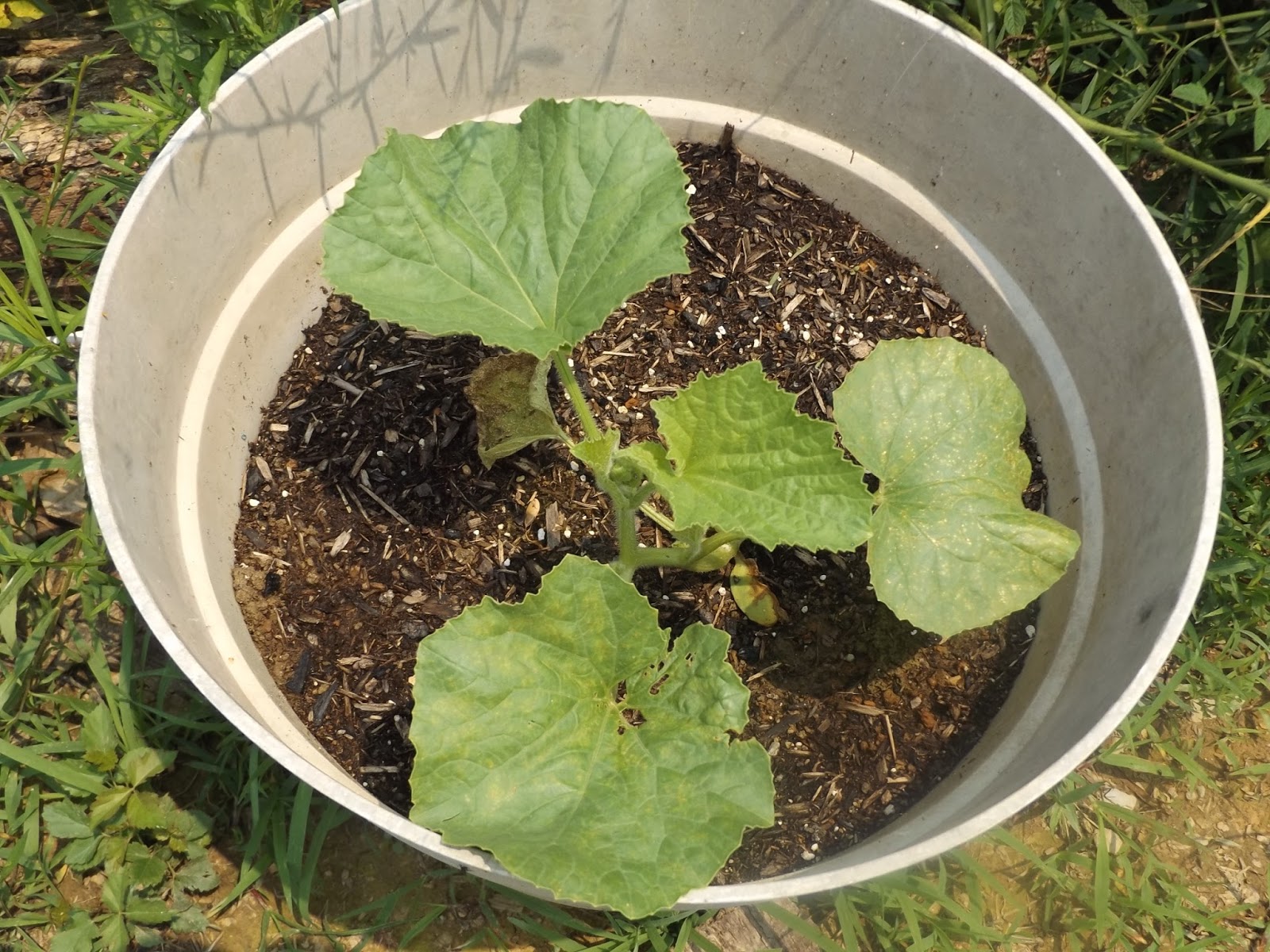
I have some plants growing in large containers, such as Luffa (loofah) plants. I have yet to make a a trellis for them. I have been eying the fencing that I was using for the raspberries, so maybe I'll fashion the fencing into a trellis for them. For the cucumber plants, I leaned a pallet up against a building for the cucumbers to grow upwards, and also a piece of a baby crib for another container of cucumbers. Other vegetables I have growing in containers include Tomatoes, black eyed peas, black beans, and a melon plant that is either Santa Claus or Canary melon.