Showing posts with label cover trash. Show all posts
Showing posts with label cover trash. Show all posts
Saturday, August 15, 2015

Saturday, April 25, 2015
Beautify the world with guerrilla gardening, graffiti art & tips on seed bombing
After I began
seeing the Dogwood and Red bud trees flowering weeks ago, I wanted to discuss this topic of beautifying the world. Alongside the
roads and almost every backyard, there was a line of pink and white blooming trees. I
thought, "How beautiful would this world be if everyone
planted flowering trees and created a food forest in their yard?"
I think of the Wisteria Tunnel in Japan, and wonder why we haven't implemented something as magical and inviting as that to the landscapes around us. Plants, trees, and gardens are pieces of artwork that provoke conversation and bring people together. And, you can certainly beautify the landscape at every season. For example, in the Spring, the Dogwood and Red bud trees are blooming along with the fruit trees; and in the Fall, the Hickory tree leafs and Burning bush grace us with Fall colors of yellow and red. Added benefits of planting trees and flowers to the landscape: provide color, food for bees and animals, provide free food for families, and adding oxygen while reducing CO2.
In Spring, spot blooming trees or flowers alongside the roads. Take cuttings from trees you want to implement in your own food forest, or dig up flowers to add to your garden. Once you have collected cuttings from trees, cut any bottom branches from your cutting and shave the bottom of your butting with pruning shears. Then add rooting hormone to stimulate root growth. Finally plant the cutting in a pot with some potting mix or soil. Label your trees and plants, and as your cuttings become larger, plant outdoors in the ground, then add compost and mulch around the base of your tree.
Dingy streets, gray buildings, and dark alleys create an ominous atmosphere, consequently, growing up within these environments extends into peoples' own emotions, relationships, and livelihood.
Colors really do affect your mood, and I hypothesize this is true for those living in colorless city and urban environments. Colors of green, blue, brown, and yellow are found in the grass, sky, dirt, and sun--all of which symbolize nature. Being in nature truly creates a tranquil effect on the body. Specifically the color of green symbolizes nature, fertility, and life. Chlorophyll gives leaves their green color. The green pigment in plants is refreshing and relaxing on the eyes, and actually has been claimed to improve vision. A couple of plants growing in homes could prevent irritability.
I think of the Wisteria Tunnel in Japan, and wonder why we haven't implemented something as magical and inviting as that to the landscapes around us. Plants, trees, and gardens are pieces of artwork that provoke conversation and bring people together. And, you can certainly beautify the landscape at every season. For example, in the Spring, the Dogwood and Red bud trees are blooming along with the fruit trees; and in the Fall, the Hickory tree leafs and Burning bush grace us with Fall colors of yellow and red. Added benefits of planting trees and flowers to the landscape: provide color, food for bees and animals, provide free food for families, and adding oxygen while reducing CO2.
In Spring, spot blooming trees or flowers alongside the roads. Take cuttings from trees you want to implement in your own food forest, or dig up flowers to add to your garden. Once you have collected cuttings from trees, cut any bottom branches from your cutting and shave the bottom of your butting with pruning shears. Then add rooting hormone to stimulate root growth. Finally plant the cutting in a pot with some potting mix or soil. Label your trees and plants, and as your cuttings become larger, plant outdoors in the ground, then add compost and mulch around the base of your tree.
Dingy streets, gray buildings, and dark alleys create an ominous atmosphere, consequently, growing up within these environments extends into peoples' own emotions, relationships, and livelihood.
Colors really do affect your mood, and I hypothesize this is true for those living in colorless city and urban environments. Colors of green, blue, brown, and yellow are found in the grass, sky, dirt, and sun--all of which symbolize nature. Being in nature truly creates a tranquil effect on the body. Specifically the color of green symbolizes nature, fertility, and life. Chlorophyll gives leaves their green color. The green pigment in plants is refreshing and relaxing on the eyes, and actually has been claimed to improve vision. A couple of plants growing in homes could prevent irritability.
With only the sight of plants, people naturally experience an uplifting attitude. Plants have a distractive, engrossing affect that focuses your attention.
By adding perennial flowers, vegetable gardens, fruit trees, and colorful artwork in the ghettos, neglected towns, all highways and interstates, and any city and urban environments, we can potentially create a Food Forest that is inviting, artistic, innovative, peaceful, beautiful, and ecologically sustainable for the world.
In the same ghettos or impoverished areas will benefit from guerrilla gardening. Those who need the food the most will come to the gardens to eat for free.
By adding perennial flowers, vegetable gardens, fruit trees, and colorful artwork in the ghettos, neglected towns, all highways and interstates, and any city and urban environments, we can potentially create a Food Forest that is inviting, artistic, innovative, peaceful, beautiful, and ecologically sustainable for the world.
In the same ghettos or impoverished areas will benefit from guerrilla gardening. Those who need the food the most will come to the gardens to eat for free.
Ron Finley, a Los Angeles resident is leading by example using guerrilla gardening methods. Finley is the co-founder of LAGREENGROUNDS.ORG, a company that plants gardens in low-income homes in the Los Angeles area as a part of a recovery system to transform neighborhoods. In 2013, he gave a TED talk on his progress as a "guerrilla gardener". "Guerrilla" is synonymous with rebellion. Guerrilla gardening refers to the act of gardening on land that people do not have legal rights to utilize. Below is a picture of Ron Finley at work to beautify what looks like an abandoned pool or skate park.
This idea of cleaning up neighborhoods and abandoned locations that become crime zones, could be transformed into a beautiful and inviting garden. Cleaning waste dumps can be transformed into parks, which would clean the environment. I have brought up this topic before: Ways to Clean Trash/waste landfills.
 |
| Freedom Hall |

You do not need to implement raised beds in a guerrilla garden. In fact you can make 100 or more seed bombs that will take out the hard work of making raised beds. Seed bombs are essential balls of soil with seeds inside. The intention of seed bombs is to throw out and scatter in abandoned lots, ditches, or any unused location. Guerrilla gardening emphasizes growing food anywhere and everywhere, so this is where throwing out seed bombs is much easier for growing food--especially when the intent is to not get caught growing food on private property.
Masanobu Fukuoka has been credited to the invention of seed bombs. They are easy to make but if there is insufficient amounts of rain, this will prevent or slow germination.
 |
The great aspect about vegetable seeds is that they can grow in poor soil and tiny nooks in pavement. I have seen a tomato growing in a window sill and in the crevice of a doorway. The vegetables that grow best in small spaces are lettuce, spinach, and kale. In locations that receive excess moisture (like in ditches), throw out melon and squash seed bombs. In locations that receive lots of sunlight, throw out Tomato and Pepper seed bombs; and Brussels in shady locations. If the soil looks poor, grow Tomatoes, beans, and greens.
The sight of gardens and flowers is an artistic creation. But I also find that graffiti art beautifies the ugly atmosphere of urban and city life. Graffiti art is synonymous with rebellion and activism, and I think this topic works perfectly alongside guerrilla gardening.
Photos I posted below are great examples of graffiti art that can create an uplifting attitude in the most dismal looking environments.
 |
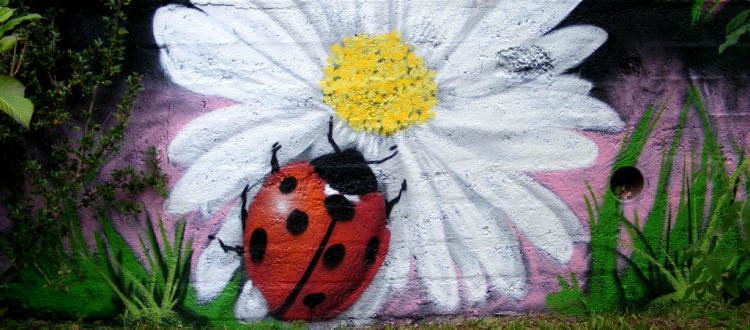 |
| photo from Fresh Paint |
Friday, February 27, 2015
Ways to Clean Trash/waste landfills
It's so easy to throw away trash and have it hauled off every week to be taken to a dump. I imagine a festering mountain of trash that could be transformed into a green mountainous landscape, like the Israel Hiriya garbage dump that was once "Shit Mountain" with 25 million tons of trash. After the government closed the landfill, the dump was contained within the slopes and walls of the mountain stabilized and reinforced "using salvaged concrete debris from construction projects. Then the landfill was capped and covered, which allows Ayalon Biogas to collect methane produced by the still rotting garbage, which is used to power a textile factory" according to Treehugger. Six years later in 2004, landscape architect Peter Latz designed a way to rehabilitate the area, while avoiding to flatten the mountain. The west tip of the mountain features a pergola and scenic vista.
The mountain represents a vision of the future, using Human's ability to transform our mistakes into solutions that will enhance symbiotic relationships between the land, humans, and other beings.
Nine other landfills were turned into Nature Preserves, such as Pulau Semakau, Tifft, Buffalo, Mount Trashmore, Virginia Beach, Bukit Tagar, Malaysia, Millennium Park, Massachusetts, Chambers Gully, Australia, Sai Tso Wan, Hong Kong,
Freshkills Park, New York, and Cesar Chavez Park, Berkeley.
The propagation of mushrooms all across waste sites and disaster zones have been known to clean oil spills and nuclear meltdowns. Eric Rasmussen, a former Defense Department scientist and disaster expert, is collaborating with Paul Stamets to decontaminate the zone around Japan’s Fukushima nuclear reactor with mushrooms. Although methods for cleaning disaster and waste zones may take decade, Paul Stamets suggests several precautions and steps to cleaning the site, for example:
"1. Evacuate the region around the reactors.
2. Establish a high-level, diversified remediation team including foresters, mycologists, nuclear and radiation experts, government officials, and citizens.
3. Establish a fenced off Nuclear Forest Recovery Zone.
4. Chip the wood debris from the destroyed buildings and trees and spread throughout areas suffering from high levels of radioactive contamination.
5. Mulch the landscape with the chipped wood debris to a minimum depth of 12-24 inches.
6. Plant native deciduous and conifer trees, along with hyper-accumulating mycorrhizal mushrooms, particularly Gomphidius glutinosus, Craterellus tubaeformis, and Laccaria amethystina (all native to pines). G. glutinosus has been reported to absorb – via the mycelium – and concentrate radioactive Cesium 137 more than 10,000-fold over ambient background levels. Many other mycorrhizal mushroom species also hyper-accumulate.
7. Wait until mushrooms form and then harvest them under Radioactive HAZMAT protocols.
8. Continuously remove the mushrooms, which have now concentrated the radioactivity, particularly Cesium 137, to an incinerator. Burning the mushroom will result in radioactive ash. This ash can be further refined and the resulting concentrates vitrified (placed into glass) or stored using other state-of-the-art storage technologies.
By sampling other mushroom-forming fungi for their selective ability to hyper-accumulate radioactivity, we can learn a great deal while helping the ecosystem recover. Not only will some mushroom species hyper-accumulate radioactive compounds, but research has also shown that some mycorrhizal fungi bind and sequester radioactive elements so they remain immobilized for extended periods of time. Surprisingly, we learned from the Chernobyl disaster that many species of melanin-producing fungi have their growth stimulated by radiation" (Permaculture: Practical solutions for self-reliance).
I have mentioned many times how to use Trash, waste, and other recyclable materials in the garden and when constructing the home, which you can see in some of my posts: Construct a Greenhouse using Free supplies, Recycled Cardboard box garden, Recycled (car/truck) Tire Gardens, and Cloches plant protection (early planting & extend growing season). I did mention that using car/truck tires for growing vegetables is not recommended, but many gardeners do this. In other words, if you don't feel comfortable using plastic, pallets, tires, or cardboard in your garden, don't use them.
Specifically on this topic, I wanted to present how I have been handling Trash/waste that I cannot use in the garden or home. There are simply materials that are dangerously laden with chemicals that you cannot use for the vegetable garden. For example, in the last couple of years, James and I have remodeled my mother's home; and in doing so, we have accumulated trash such as drywall, bits of wood, and roof materials we had to pile up in the yard. Instead of taking these things to a landfill (which you have to pay to discard), I spread the waste out to be covered with sticks, then straw, dirt, and mulch. At first I will use the bed for growing non edible plants.
You can see from the photo below the drywall is scattered level, then I have layered twigs/sticks on top. After that I will add layers of straw or grass, then dirt from around the yard, then add mulch to plant flowers. This took about an hour or two to assemble and gather the materials myself. I think if I have another couple of hours I will be able to finish the bed for planting.
Considering this spot is on the West side of the home, it doesn't get much sun, so I will plant flowers/plants that do not require much sunlight like Hostas and Ferns. Actually I have a post on flowers that shade tolerant: List of Shade & Cold tolerant plants (vegetables, herbs, flowers).

"As of 2010, Total MSW generation was 250 million tons. Organic materials continue to be the largest component of MSW. Paper and paperboard account for 29% and yard trimmings and food scraps account for another 27%; plastics 12%; metals 9%, rubber, leather and textiles 8%; wood is approximately 6.4% and glass 5%. Other miscellaneous wastes make up approximately 3.4%" (EPA).
With many of the landfills that exist and radioactive places of the world, we can cover with wood material and grow mushrooms that will clean and absorb radioactivity. You could cover dumps in dirt and mulch then grow trees on top. Of course they do not have to edible fruit or nut trees, but you could grow any types of Trees, and actually grow only fruit/nut bearing trees for the wildlife to create an environment promoting life.
The reason I advocate for using recycled materials is to keep trash OUT of the landfills, however I am not advocating for MORE trash like plastics, cardboard, paper, and glass to be manufactured at all! In fact, I see the use in technology of computers and books, but we do not need to create so much waste per person.
Any foods made in a factory, any clothes, and other useless junk do not contribute to Human evolution and potential. With all of the clothes that already exist, we can cloth every person. There is no need to make anymore clothes when we can all shop at goodwill; with all the food produced in the world, we can feed every person. The reason not every child is fed because of consequential actions of the rich vs poor and livestock industry that grow grains for animals. With all the plates, cups, jars, and silly trinkets that exist we can furnish every home.
Where necessity is concerned, we don't need frying pans, blenders, food processors, bowls, plates, and cups to eat when Fruit harvested from trees are perfectly designed for immediate satisfaction. It's no coincidence that all other animals eat raw-- that's how we were designed to eat.
We can grow our own food by propagating from fruit and nut trees; make our own homes out of clay dirt, straw, and sand for free (see here), we can make our own pottery by firing clay soil with sand. What we produce such as computers and technologies can be made in factories that harness Sun energy for power, and re-route pipes that release carbon emissions into the ground which the plants will use and clean the air (known as Carbon sequestration).
These solutions are already implemented, however this generation is in a transition period of using COAL, Petroleum oil, burning fossil fuels, creating trash, polluting air and water, eating animals. I see a small light at the end of the tunnel for centuries to come...
 |
| Hiriya landfill turned into a park |
Nine other landfills were turned into Nature Preserves, such as Pulau Semakau, Tifft, Buffalo, Mount Trashmore, Virginia Beach, Bukit Tagar, Malaysia, Millennium Park, Massachusetts, Chambers Gully, Australia, Sai Tso Wan, Hong Kong,
Freshkills Park, New York, and Cesar Chavez Park, Berkeley.
The propagation of mushrooms all across waste sites and disaster zones have been known to clean oil spills and nuclear meltdowns. Eric Rasmussen, a former Defense Department scientist and disaster expert, is collaborating with Paul Stamets to decontaminate the zone around Japan’s Fukushima nuclear reactor with mushrooms. Although methods for cleaning disaster and waste zones may take decade, Paul Stamets suggests several precautions and steps to cleaning the site, for example:
"1. Evacuate the region around the reactors.
2. Establish a high-level, diversified remediation team including foresters, mycologists, nuclear and radiation experts, government officials, and citizens.
3. Establish a fenced off Nuclear Forest Recovery Zone.
4. Chip the wood debris from the destroyed buildings and trees and spread throughout areas suffering from high levels of radioactive contamination.
5. Mulch the landscape with the chipped wood debris to a minimum depth of 12-24 inches.
6. Plant native deciduous and conifer trees, along with hyper-accumulating mycorrhizal mushrooms, particularly Gomphidius glutinosus, Craterellus tubaeformis, and Laccaria amethystina (all native to pines). G. glutinosus has been reported to absorb – via the mycelium – and concentrate radioactive Cesium 137 more than 10,000-fold over ambient background levels. Many other mycorrhizal mushroom species also hyper-accumulate.
7. Wait until mushrooms form and then harvest them under Radioactive HAZMAT protocols.
8. Continuously remove the mushrooms, which have now concentrated the radioactivity, particularly Cesium 137, to an incinerator. Burning the mushroom will result in radioactive ash. This ash can be further refined and the resulting concentrates vitrified (placed into glass) or stored using other state-of-the-art storage technologies.
By sampling other mushroom-forming fungi for their selective ability to hyper-accumulate radioactivity, we can learn a great deal while helping the ecosystem recover. Not only will some mushroom species hyper-accumulate radioactive compounds, but research has also shown that some mycorrhizal fungi bind and sequester radioactive elements so they remain immobilized for extended periods of time. Surprisingly, we learned from the Chernobyl disaster that many species of melanin-producing fungi have their growth stimulated by radiation" (Permaculture: Practical solutions for self-reliance).
I have mentioned many times how to use Trash, waste, and other recyclable materials in the garden and when constructing the home, which you can see in some of my posts: Construct a Greenhouse using Free supplies, Recycled Cardboard box garden, Recycled (car/truck) Tire Gardens, and Cloches plant protection (early planting & extend growing season). I did mention that using car/truck tires for growing vegetables is not recommended, but many gardeners do this. In other words, if you don't feel comfortable using plastic, pallets, tires, or cardboard in your garden, don't use them.
Specifically on this topic, I wanted to present how I have been handling Trash/waste that I cannot use in the garden or home. There are simply materials that are dangerously laden with chemicals that you cannot use for the vegetable garden. For example, in the last couple of years, James and I have remodeled my mother's home; and in doing so, we have accumulated trash such as drywall, bits of wood, and roof materials we had to pile up in the yard. Instead of taking these things to a landfill (which you have to pay to discard), I spread the waste out to be covered with sticks, then straw, dirt, and mulch. At first I will use the bed for growing non edible plants.
You can see from the photo below the drywall is scattered level, then I have layered twigs/sticks on top. After that I will add layers of straw or grass, then dirt from around the yard, then add mulch to plant flowers. This took about an hour or two to assemble and gather the materials myself. I think if I have another couple of hours I will be able to finish the bed for planting.
Considering this spot is on the West side of the home, it doesn't get much sun, so I will plant flowers/plants that do not require much sunlight like Hostas and Ferns. Actually I have a post on flowers that shade tolerant: List of Shade & Cold tolerant plants (vegetables, herbs, flowers).
"As of 2010, Total MSW generation was 250 million tons. Organic materials continue to be the largest component of MSW. Paper and paperboard account for 29% and yard trimmings and food scraps account for another 27%; plastics 12%; metals 9%, rubber, leather and textiles 8%; wood is approximately 6.4% and glass 5%. Other miscellaneous wastes make up approximately 3.4%" (EPA).
With many of the landfills that exist and radioactive places of the world, we can cover with wood material and grow mushrooms that will clean and absorb radioactivity. You could cover dumps in dirt and mulch then grow trees on top. Of course they do not have to edible fruit or nut trees, but you could grow any types of Trees, and actually grow only fruit/nut bearing trees for the wildlife to create an environment promoting life.
The reason I advocate for using recycled materials is to keep trash OUT of the landfills, however I am not advocating for MORE trash like plastics, cardboard, paper, and glass to be manufactured at all! In fact, I see the use in technology of computers and books, but we do not need to create so much waste per person.
Any foods made in a factory, any clothes, and other useless junk do not contribute to Human evolution and potential. With all of the clothes that already exist, we can cloth every person. There is no need to make anymore clothes when we can all shop at goodwill; with all the food produced in the world, we can feed every person. The reason not every child is fed because of consequential actions of the rich vs poor and livestock industry that grow grains for animals. With all the plates, cups, jars, and silly trinkets that exist we can furnish every home.
Where necessity is concerned, we don't need frying pans, blenders, food processors, bowls, plates, and cups to eat when Fruit harvested from trees are perfectly designed for immediate satisfaction. It's no coincidence that all other animals eat raw-- that's how we were designed to eat.
We can grow our own food by propagating from fruit and nut trees; make our own homes out of clay dirt, straw, and sand for free (see here), we can make our own pottery by firing clay soil with sand. What we produce such as computers and technologies can be made in factories that harness Sun energy for power, and re-route pipes that release carbon emissions into the ground which the plants will use and clean the air (known as Carbon sequestration).
 |
| carbon sequestration |
Subscribe to:
Posts (Atom)