Showing posts with label homesteading supplies. Show all posts

Monday, January 23, 2017

Gardening economics: The Top 3 Questions I get asked

Often when I exhibit my garden harvests, people immediately start asking me how much I spend each year on gardening supplies, how much food I produce, and how much land I'm working with. These questions will be answered here, and I hope this is useful to all those that are curious and want to work with their own slice of land to grow food where ever and when ever.

1. How much do you spend on your garden every year?

Typically every year in the Spring, I buy $20 of mulch which is a truck load, and I spread that on the garden to start transplanting seedlings. Sometimes I will end up buying another truckload up mulch at the beginning of Fall for the fruit trees, so that will come to $20-40 in mulch every year. Then of course because I plant a lot in containers, I usually end up buying $30 in garden soil or potting soil. As for seeds, I typically do not need to buy seeds because I have been saving seed from my own crops for years, and I hoard seeds for the following year, so I don't usually spend any more than $20 on seeds. Although for the first couple of years I was buying $50-60 worth of seed to start my Non-gmo organic seed collection. And I always buy some plants at the nursery to get started early such as brassicas, tomatoes, or peppers that often take a long time to grow for a regular gardener, so I will spend no more than $20 on a certain type of plant every year. With all that factored in, I will usually spend approximately $90-110 total every year.

2. How much food do you produce?

Actually this is very hard to calculate because the foods I harvested were organic, some wild edibles, and some foods that are very unique that they may be quite expensive. For example, the figs that I grow and harvest, I'm not sure what they would equate to be because I have never been to a grocery store that sold fresh figs like they do in California. To calculate how much food I produced last year, I skimmed some harvest photos, and I would estimate that I grew over $400 worth of food.

Actually, this is a low estimate because like I said, I grew lots of fruit that I have nothing to compare the price to, especially the wild mushrooms I picked. In fact, I grow unique fruits and vegetables that add value to the garden. To get an idea of a big harvest for me in the garden, below I have posted photos of my garden harvests for the last couple of years:

2013

minus the peaches! 2014

2014

2015

2015

2015

2015

2016
Because I'm calculating last year's garden harvest, I actually got back less because I didn't garden as much last summer as I have done previous years where I've had help. In previous years without growing and harvesting peaches and figs and wild mushrooms in the garden, I was growing $1000 every summer in squashes, greens, tomatoes, and peppers. 

3. How much land are you working with?

In previous years I have been permitted to use my grandparents' gardens that they grew on for decades, and now I have taken it over to use. I'm not quite sure what the footage of this garden is behind their house, but I will estimate that it's a 60-70 foot long garden and 15 foot in width. The garden in front of their house that I have been using is a little smaller, but still a lot larger than the garden at my house. This one is probably 50 feet in length, and the garden I work with at my house (on my mother's property) is perhaps a little more than 40 feet in length. On my mother's property (which is 0.6 acres), I grow fruit trees all over the garden and around the house. There is over 14 fruit trees on the property (cherry, plum, peach, nectarine, pear, figs), and over 20 fruiting bushes (blueberries, grapes, raspberries, aronia, blackberries, goji.)

Of course, not everyone has even the small amount of land I'm working with, so I want to mention that I have many posts on growing in containers indoors, and growing food as an apartment dweller, so I recommend reading those posts if you're an aspiring gardener that does not have their own land yet. Here are some suggested posts to visit for apartment dwellers:

Grow Veggies & Fruit trees in Containers (Limited Space & Urban gardening)

Recycled Bucket Gardening (container gardening for apartment dwellers)

1200 square foot apartment garden

Wednesday, May 20, 2015

How to Start a Small Permaculture Nursery and Grow 1000s of Trees by Yourself

 
In summary, several actions must be taken and research required to start a small-scale permaculture nursery:
 
  • Fruit Trees are propagated by grafting or budding a desired variety onto a suitable rootstock. Trees can be also propagated from seed, but then it will not grow “true” to the variety of either parent from which it originated.
  • You can learn about propagation by reading books, watching videos, attending workshops and learning from skilled orchardists.
  • Start by analysing what grows in your area and understand your local biome, consult other growers to see what works locally.
  • Think about what you want from your trees and what your goals are – is it for juice, jam, cider or fresh fruit?
  • Buy pre-grafted trees to take cuttings from, or get scion wood from other people’s trees and by trading with others.
  • Grow your rootstock from seed or buy just one and clone it. If you have capital buy rootstock in bulk.
  • Set up a small home nursery or plant directly on site, you can start as small as you want and expand gradually.
  • Start seeds in buckets, seed pits, nursery boxes or nursery beds, and, if needed, graft on later.
  • Use nursery beds and a standard nursery setup to grow vast amounts of trees and transplant on-site later.
  • Thursday, November 21, 2013

    Constructing our own home: cob building, homesteading, & free materials

    Birds, squirrels, ants, and other species construct their own shelters out of readily available materials, like sticks, rope fiber, straw, mud, and other debris. Us, on the other hand, hire a team of workers to build our homes using drywall, wood panels, laminate flooring, paint, insulation, and other toxic and refined materials.
    If you're fortunate you can build your own home; but like most of us we have to search for a vacant home at an affordable price. My mother bought home in the 90's for around $10K, and the house was built in the 1930s! It was always falling in and everything is always breaking, or pipes are freezing and breaking. 
    Unfortunately, even the simplest and decent of homes can cost up to $100,000. This could take ten or 20 years to pay off.
    I don't want to spend my entire life going to school for training, then working over 20 years at an unfulfilling job...


    We could learn from the animals, for example building our homes for free or little cost by constructing it ourselves using the same materials other animals use.


    I believe we can and should build our homes out of non-toxic, free available materials, such as the wild animals do. 'cob', 'strawbale', 'earthbag', and earthship homes are examples of how we can use readily available materials efficiently and adapt to our needs.


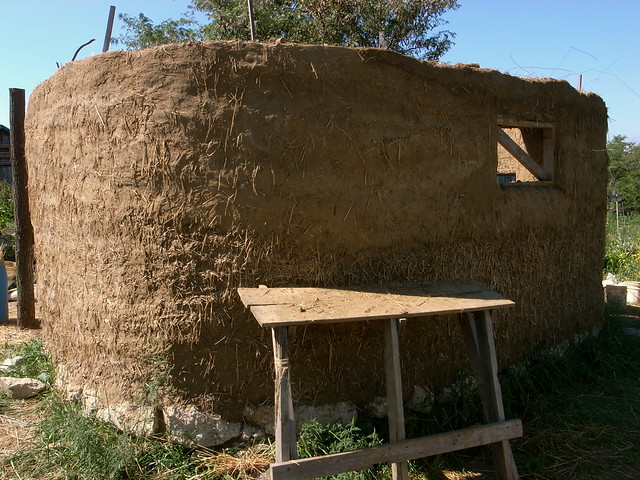
    I prefer the cob (straw, sand, and clay) method because I have these materials in abundance. The ground is clay, dried grass is straw and the creeks are full of sand. I intend to create a similar construction as this couple has done in the picture below. It requires no wood for frames; and instead the walls are built up with slabs of mud, straw, and sand until you have reached the desired height. Although this method seems unsteady, it is not-- because the materials mixed creates the consistency of concrete.
    The couple that built the home (in the picture), took approximately 9 months to construct and several months to dry out.
    For the step-by-step process (with pictures), go to their photo album here:
    "Year of Mud" The couple has several photo albums of their cob, and all natural building workshops as well as gardening photos on their Flikr page too.
     

    For other references on building with cob, read "The Hand-sculpted house book" by Mike Smith, Ianto Evans, and Linda Smiley. Refer to Ianto Evan's and Leslie Jackson's book on heating your cob home: Rocket mass heaters.
     
    My vision for a cob home would be somewhat of a nook. Perhaps as small as a normal sized kitchen! First the area will require leveling the ground, then digging a ditch in the outline of the shape of the home. It will be as small as a large shed, with one room to house dried herbs, books, some food, and a bed. I want a small frame that will allow us to save time on constructing the house while encouraging us to be outside instead of cooped up inside.
     
    For those with no money or property, can experiment with building a debris shelter in the woods. In this case, you want to live absolutely free or temporarily in the woods, read a more recent post of mine "Semi-Permanent Debris Shelters (Minimal Living or living in the woods)" where I discuss how to build a shelter out of sticks and leaves. These debris shelters remind me of bird nests with more coverage.


    bed made by monkeys


    I want to live in a world where everyone views their life simply: We get our basic needs met through Homesteading (food, water, shelter) which involves gardening, collecting free energy (sun and water), and building an all natural home. Live self reliant, independent, sustainable, and free as the animal you are.


    Monday, January 7, 2013

    What you need for homesteading (Full list of materials and supplies)

    There are many questions to homesteading, especially since independence is somewhat a frightening concept. Homesteading takes much time to learn the skills and techniques that surrounding gardening, building, and crafting. Perhaps it will take you five to 10 years to become a proficient gardener. Likewise, homesteading is the "old" and "new way" of living; because we can learn from our relatives how to build a home and grow food; but we can also learn from young folks how to coincide sustainably with nature, humans, and technology.

    At length, homesteading requires much dedication, investment, creativity, frugality, and resources. But, where do you start? Do I start looking for land for sale? How much time can I invest in building my home? How much time can I invest in growing a garden?


    All of those questions will be answered or have been answered throughout my blog; but I want to use this blog post to point out a FULL LIST OF MATERIALS you will need for homesteading. This list will assist you in estimating your budget/investment. By providing you a list of supplies you will need, this will give you the opportunity to think creatively: what materials can I make? What materials can I borrow? And, what materials do I have to buy? For example, a ladder does not have to be purchased; instead, you can build your own ladder out of free recycled wood (found at pallet shops, sawmills, or pallets behind grocery stores.)


    If you see something I missed, please comment below, and I will add it!
     
    A
    Ash (compost)
    Axe
    B
    Bamboo (posts, stakes)
    Barrels (Rain)
    Batteries
    Battery Charger
    Beams (wood posts)
    Books (philosophy, instructional, garden, fiction)
    Bottles (starting seeds indoors)
    Bricks (rock, stone)
    Brushes (painting, plastering)
    Buckets (5 gallon)
    C
    Calculator
    Canner (pressure cooker)
    Carpenter's Level
    Cart (wheelbarrow)
    Cellar (cold storage)
    Chains
    Chainsaw
    Chairs (home)
    Chalk line
    Cheesecloth
    Chicken wire
    Clamshell digger (post hole)
    Compost (organic)
    CONTAINERS (unique gardening)
    Cooler (food storing)
    Crates (storage)
    Cultivator (rototiller)
    D
    DC>AC inverter (solar panels)
    Decor (outdoor/garden)
    Dehydrator
    Door (home)
    Drill (speed)
    Drill bits
    Drums (55-gallon)
    Duct tape

    E
     F
    Fencing (wire)
    Fertilizer (organic)
    Forks (garden)
    Freezer (cooler, food storage)
    Froe
    G
    Galvanized screening (sifting)
    Garden hose
    Generator 
    Gloves
    Goggles (safety)
    Greenhouse(s)
    H
    Hammer
    Handkerchief (cleaning tools)
    Hand saw
     Hose (garden)
    Hoe
    I
    INTERNET
    J
    Jars (Mason)
    K
    Knife (utility)
    L
    Ladder
    Level (carpenters)
    M
    Machetes
    Mallet (wooden)
    Marker pencil
    Mattock
    Measuring tape
    Mulch
    N
    Nails
    O
    Organic SOIL 
    Outdoor Decor 

    Oven (made from sand, clay, & straw)
    P
    Pallets (recycled wood for trellis)
    Pencils (marker)
    Pickax
    Pinch bar
    Pitchfork 
    Plants (vegetable plugs, flowers)
    Plastic sheeting (black & Clear)
    Pliers
    Pocket knife
    Poles (posts, beams)
    Post hole digger
    POSTS (beams)
    Pots (Flower, vegetable, herbs)
    Pressure Cooker (canner)
    Pruning shears 
    Pulaski
    Q
    R
    Rain barrels
    Rake 
    Rock minerals (improving soil)
    ROCKS (decor, building structures)
    Rope
    Roof structure (metal, shingles, lumber)
    Root Cellar (cold storage)
    Rototiller
    Ruler (yardstick)
    S
    Safety goggles
    Sand (for garden & home material)
    Saw (hand or chain)
    Saw horses
    Screens (galvanized)
    Screwdriver
    SEEDS (flower, herb, veggie, fruit)
    Shears (pruning)
    Sheets (plastic, tarp)
    Shovel
    SOIL (organic gardening)
    Solar panels
     SPACE (for gardening)
    Spades (digging)
    Sponge (finishing interior of home)
    Stakes (posts or poles)
    Step ladder
    String (hemp, rope)
    Swanson square
    T
    Table (home)
    TARP (plastic sheeting)
    Tape measure
    Tiller (rototiller)
    Tool box
    Trays (starting seeds)
    Trellises (Arbors)
    U
    Utility knife
    V
    W
    Watering system
    Wheel barrel
    Windows (home)
    Wood mallet
    Wood posts (beams for home)
    Wood stove
    Worms (compost)
    X
    Y
    Yardstick (ruler)
    Z

    Keep in mind, you may not need most of these items. In fact, you may not need windows, doors, or tables because you do not plan on making a home or shed. 
    Then again, if you are planning to build your own home, you may need MORE than what's listed above. A new home-owner needs silverware, kitchen appliances,  bed sheets, pillows, etc. If you want to build your own home -- keep in mind that I have not listed exact building materials. Here is an idea of basic materials you may need for your home:

    For the foundation of the house you may need rocks, bricks, concrete, or gravel. For structure of home (cob walls), you will need clay soil, sandy soil or sand, water, and straw. For roofing, you'll need lumber, poles, boards, and windows. Of course, you'll need glass or windows, doors, hinges, knobs, etc.

    Again, if I missed an important tool or material, please comment below and I will add it to the list.

    How much money have you invested in homesteading, so far? I have the luxury of borrowing most of my Grandfather's tools and supplies, as well as the space to grow food and build a home. I'm very fortunate for this!