Sunday, January 8, 2017

How many people lack access to clean drinking water?

After Flint changed its water source to the Flint River, its drinking water had a water crisis from lead contamination. So, let's not forget that this is a political power issue where those in power were not concerned about the people. Of course this power has to do with "saving" money by switching water sources while also failing to change the pipes in that water source. Thus, between 6,000 to 12,000 children have been exposed to drinking water with high levels of lead, experiencing a range of serious health problems.
With the ongoing crisis in Flint, Michigan, we must ask ourselves: how many people lack access to clean drinking water?
Because some of us who live in a comfortable home with running water, sometimes we forget that many in the rest of the world does not have the same luxury. According to the WHO based on 2015 findings, 2.6 billion people lack even a simple ‘improved’ latrine and 1.1 billion people has no access to any type of improved drinking source of water. In 2010, that number was 783 million people who did not have access to clean drinking water (37% of those people live in Sub-Saharan Africa). At the time 1 in 9 people world wide did not have access to safe and clean drinking water in 2010.

As a direct consequence, in developing countries, as much as 80% of illnesses are linked to poor water and sanitation conditions according to the United Nations--For example, 1.6 million people die every year from diarrhoeal diseases (including cholera). Of those 1.6 million, 90% of these are children under 5, mostly in developing countries.  Other diseases attributable to lack of access to safe drinking water include,  schistosomiasis, trachoma, and intestinal helminths (ascariasis, trichuriasis and hookworm infection). This is why half of the world's hospital beds are filled with people suffering from a water-related disease!
Sadly, over half of the developing world's primary schools don't have access to water and sanitation facilities; and without toilets, girls often drop out at puberty. Thus, when water sanitation interventions are put in place, there will be a reduce in girls dropping out of school, there will be less disease and deaths.

Inventor of the Segway and iBot mobility system, Dean Kamen, created a water purification system called the Slingshot several years ago, to place in developing countries that lack access to clean drinking water. The system is powered by a Stirling engine running on a combustible fuel source. Proposed, the Slingshot is claimed to be able to produce drinking water from almost any source by means of vapor compression distillation, requires no filters, and can operate using cow dung as fuel.
Other characteristics of the machine include:


  • five years of operation without overhaul or maintenance
  • use less than a kilowatt of power (lower than the power consumption of a hair dryer)
  • generate 1000 liters of pure water/day, enough for 100 people for hygiene and cooking
  • meets the U.S. pharmacopoeic standard for water for injections
  • requires no pre-treatment, pipelines, engineers, consumables (osmosis membranes, charcoal, etc.), or installation permits


  • Another water purification system, the Lifestraw, is a plastic tube that draws water up through the straw-- first passing through hollow fibers that filter water particles down. It filters a maximum of 1000 litres of water, enough for one person for one year. It removes almost all of waterborne bacteria and parasites. In addition to the classic LifeStraw, the manufacturer also produces other styles on the LifeStraw product: the LifeStraw Family, a larger unit designed for family use (Lifestraw wiki.) I have reviewed the Lifestraw, which you can watch in the video here: Lifestraw review
    It is also inexpensive. I'm not sure of the distribution of these products. I am aware that they are donated and also given in natural disasters around the world.
    But, this invention is more of a survival and wilderness tool. I am more interested in the water purification systems that are built within the home. Notice in the picture below a cistern which collects rainwater which is connected to a filter for drinkable water and in sinks. The gray water tank flushes waste water which gets distributed to plants non edible plants without a filter, and to the edible plants which will require a peat filter. This intricate system provides you the convenience and luxury of indoor plumbing and running water, while reducing water consumption.

    pinterest.com
    Once again, water is a political issue because it affects people personally those who do and do not have access to clean drinking water. Water should be a right, not a privilege. The Flint water crisis may be summed up to environmental racism because historically brown and black folks across the world have experienced this, but of course it is much more complex of an issue. So, let's make 2017 THE year that we ALL have access to clean, free, readily-available drinking water for ALL people.


    Trying Durian & Longans tropical fruit for the first time

    Often when I go to the city, I scope out tropical, rare, exotic fruits. I look for those that I haven't tried before. In the last couple of years I have tried for the first time: kumquats, cape gooseberries, guavas, fresh (homegrown) figs, red bananas, tamarind, Japanese eggplant, and jackfruit. It's a delight, a treat, and a privilege to eat these foods that are shipped from around the world to get to me in Kentucky.

    Today when I went to the city, I stopped at an Asian market; and to my surprise, I found Durian and Longans. I highly recommend the Durian, but many have said it stinks and completely will stink up an entire area for days like onions or sewage. I definitely tasted the "onion" flavor of the Durian, but really started to enjoy the Durian. I did not eat the Durian all at once because of the fat content, the Durian will give you that coma feeling that you get from eating too much or love or sex (haha!)

    Because I bought the Durian frozen, I soaked the Durian in hot water for a couple of hours. I think it needed more time to thaw, which is why I only ate a small portion of the Durian and immediately put the rest in a container the fridge. I removed all the fruit (which is like pods, as you can see in the photos); and composted the Durian skins outside due to the pungent smell. My family that was in the house with me as I cut it up said it smelled terrible.


    As for the longans, my partner enjoyed them, but I really did not it. I really cannot describe the foul taste except that it's a weird combination of fish, grapes, and something else I can't quite interpret. Food is funny like that which creates such a preponderance of our senses. 


    Thursday, January 5, 2017

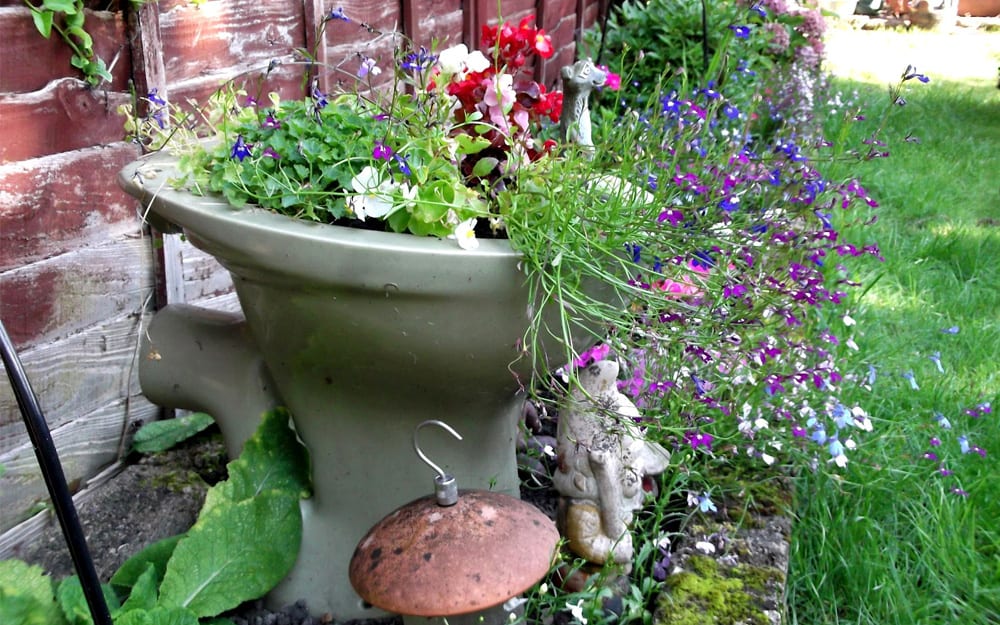
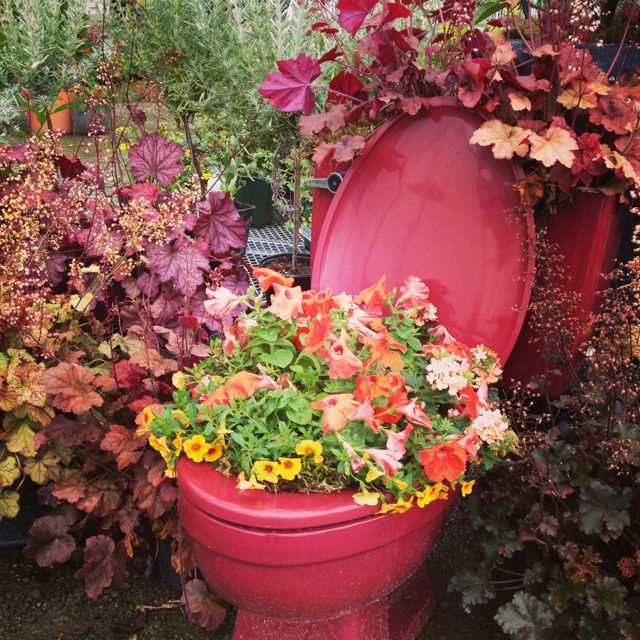
    Recycled toilet flower garden

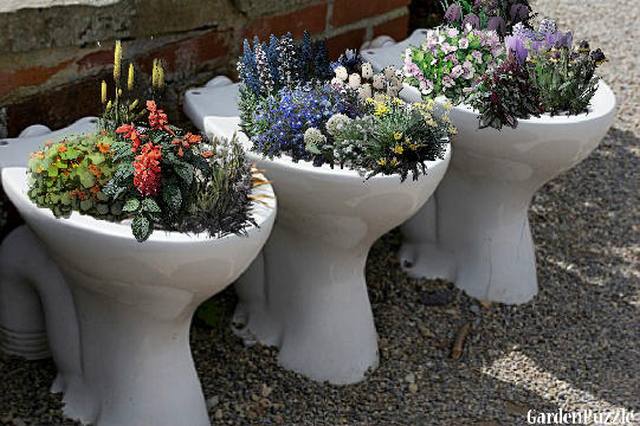
    Got an old toilet you're not sure what to do with? I actually have a toilet I put outside years ago, and haven't wanted to or had time to take it to the dump, so I wanted to reuse the toilet as a decorative piece in the garden. Here are some ways I have found to decorate and utilize your old toilet in the garden.

    pinterest

    pinterest

    ouztstoo.com

    pinterest

    pinterest
    pinterest.com


    yourhouseandgarden.com
    pickchur.com

    greenecoservices.com

    daviddomoney.com
    luxuryhomegarden.com

    sowanddipity.com

    growplumbing.com
    pinterest
    pinterest

    pinterest

    theecomuslim.com
    pickchur.com

    Weatherproofing doors & windows in the winter

    If you live in a house that has been remodeled by hippies and hillbillies over the last 80 years, you may live in a house like mine. Often I find myself covering doors with blankets in the winter; stuffing plastic grocery bags in cracks and crevices; placing rugs in doorways between rooms; in addition to covering my porch in plastic to make a greenhouse which also blocks the cold and wind on the South side which simultaneously traps sun rays/heat. I also use trash bags/sheets of plastic to cover the windows in the winter. I've seen people use bubble wrap for windows as well, which also creates an artsy appeal.
    I realize this is probably the many ways poor people attempt to keep their house warmer in the winter time. But every house has cracks and crevices that cold air and winds come through--especially around the doors and windows. But because I have holes and cracks in places of the floor in my house, I have to cover those particularly well to keep out the cold. Obviously I am not so poor I'm not using some kind of heating system. I am privileged enough to using gas heat via two wall units. And if it gets any colder, we use the portable heaters. I am disheartened by the many people that because of homelessness and forced out of society, that will either die or suffer the cold outdoors. I have slept outside when it was 50 degrees, and even 30 degrees and I complained; and I've slept outside when it was 9 degrees, but I had many blankets and another person to keep me "warm."

    Something many people around my area use is a wood stove. My grandpa cuts dead trees to use to burn for his wood stove. It is hard to come across wood for free, but he gets some that are discarded at pallet/saw mills, wood on the side of the road, he drags wood from his woods, and I give him logs that I have dragged from my neck of the woods. My grandpa also grows trees around his house to block cold winds in the winter, and shade the house to keep cool in the summer.
    diylife.com

    I grow over 15 potted (tropical) plants in the house right now, so this is also adds to the humidity. It is a good idea to get a humidifier as well for those humidity-loving tropical plants, which will also add moisture and warmth when it often seems dry in the house in winter. 

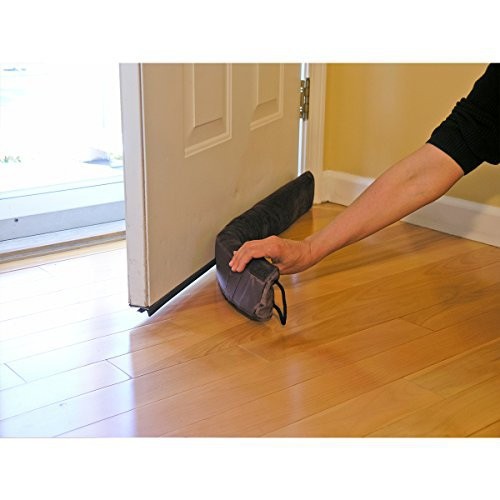
    Recently I have been using weatherstripping that is adhesive-backed foam you put around the the doorstop (seen in the picture.) I say I have been using this weatherstripping because I have been reapplying it and taking it off to put new stripping on since I have 5 cats outdoors that tear it into pieces. They claw at the stripping and completely tear it off, so I'm continually reapplying because I have the stripping outside of the door. So as I was looking for new options to keep the cats from doing this, I wanted to show you some of the ways I'm going to weatherproof my home this winter. 

    lifehacker.com


    plowhearth.com

    homeowneroffers.com

    Obviously, if you have a fireplace in your home, block the top of the chimney from the cold with plastic tarp and use rope to hold it in place. Cover the fireplace on the inside too. Double up on your drapes for the windows at night time. In the day, open the curtains/drapes to let sun in. A blog here will show you other ways to weatherproof your home and keep your house warm in the winter: 20 frugal ways to keep your house warm.
    aliexpress.com
     Also, you can do what I did with my porch and turn it into a "greenhouse" by covering it in plastic. In the pictures below is the hillbilly rigging style to turning the porch into a greenhouse. With the materials I had around my house, I screwed nail screws into scraps of wood that held the plastic in place to the roof and poles of the porch. I also laid down plastic on the floor boards to block additional cold air/winds. Additionally, I have the bottom ends of the plastic being held by bricks and cinder blocks. Like I said, I have five cats outdoors and also a dog, so this "greenhouse" was really a place for all the animals to stay warm in the winter. I assembled a tunnel system using shelves and things for the cats, and covering that with a blanket. Also laying blankets down for the dog to sleep on. These are some privileged cats and dog too because I put their blankets in the dryer to heat them. And then wrap the animals in blankets to stay warm throughout the night.