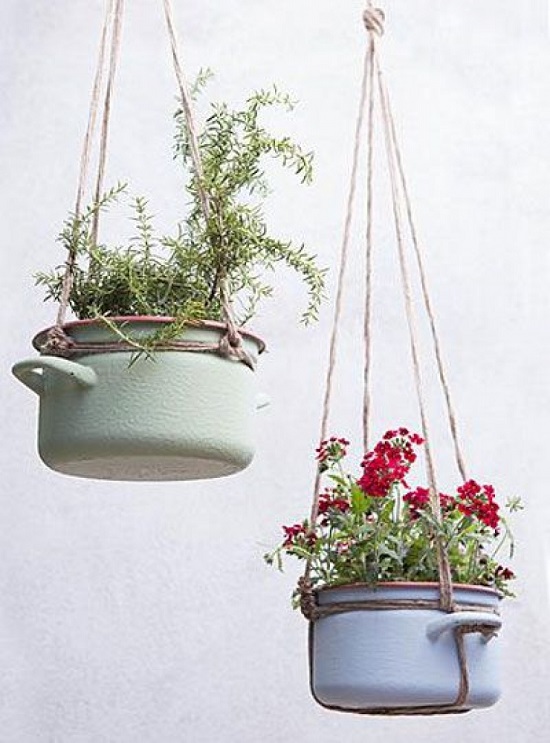
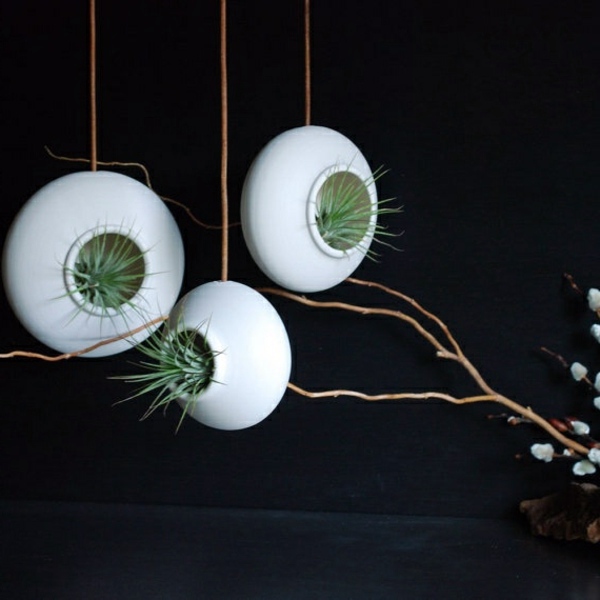
The 3M Command strips with plastic hook holds potted plants, and it's easy to put up, fast, and inexpensive. As long as the potted plants are small and light, the plastic hook should hold the plant for a long time. I have been using mine for for months for a potted String of Bananas plant.
Below are more examples of the unique ways to grow a garden indoors using a hanging method.There are additional photos of ideas to display indoor potted plants here: 99 Great Ideas to display Houseplants.
he
3M Command strips with a plastic hook holds potted plants well as long
at they're small and light. I have been using mine for months for a
potted String of Bananas plant.
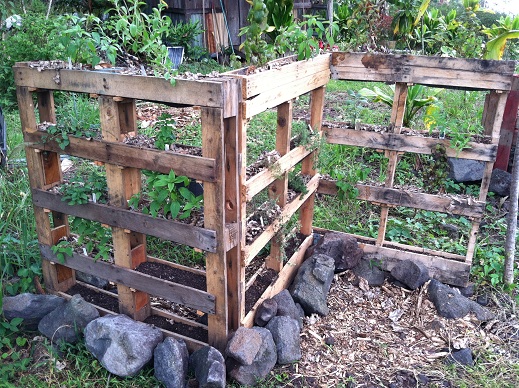
The structure of the keyhole gardens is to create a circular compost pile. Around the compost, soil is to be surrounded in a U shape built up using stacked rocks or another barrier to hold the soil around the compost. As rain falls through the compost, the nitrogen and other minerals from the compost will be slowly released like a liquid fertilizer into the soil.
The first step in making a keyhole garden is either making the cylindrical compost hole with mesh, wire, or some kind of fencing.
Secondly, make the outer frame with bricks, rocks, wood, or other materials to contain the soil. Shape the frame like a U so that you can walk in the space.
Third, lay down cardboard at the bottom of the garden to suppress weeds.
Fourth, begin by adding soil in the garden, and fill the compost cage with food scraps.
Below are examples of the many ways gardeners have made keyhole gardens.
As I read a little bit of Michael Pollan's book "In defense of food", his overall health advice was to eat the foods that grow wild around us in our own environment. His argument was that when we eat the foods around us that grow wild are those that help us adapt to the environment and prevent diseases. Pollan concludes from researching cultures that it's important to follow cultural practices in consuming food rather than food science. Additionally, the soil and plant in the wild is cleaner than that grown in the big-Ag industry with all of its spray chemicals. Because the soil in the woods has more nutrients for years of composting leaf matter and other natural fertilizing, the edible foods are more nutritious, and have a diverse range of nutrients whereas the typical store-bought food is the same mix of ingredients of wheat and sugar components in a very strict ratio with no nutrition left after processing. Although it does not have quite the vegan or ethical message as far as what I usually highlight on this blog, I do see merit in his argument. I highly recommend reading this book, so request a copy from your local library.
In considering this from Pollan's argument, I find that I also strive to eat this way considering I do a lot of foraging behind my house. My Family and people around Kentucky, especially where I live, hunt for food like deer, fish, squirrel, turkey, and so that's their way of eating life that is around them in their environment.
Because I eat vegan, the wild foods I have eaten are fruits, nuts, greens/herbs, and mushrooms. Apparently there is a App on iTunes for Vegan recipes of wild edibles here: The Wild Vegan.
In past posts on wild edibles, I have shown you that I forage for mushrooms in the woods, as well as berries and paw paw fruits. Typically the kinds of mushrooms that grow behind my house are Chanterelle mushrooms and Chicken of the Woods, in the pictures below.
For more pictures of the mushroom foraging in the past years, go to the links provided at the end of this post.
Another mushroom found in Kentucky is Morels. When I was a kid, my Dad and I foraged for these and later he fried them and ate them with ketchup. This how I ate them growing up. I haven't had Morels in a long time because they grow early in the season, and I haven't come across a patch of Morels around my house. Because Chanterelles and Chicken of the woods grow behind my house, those are what I forage the most. I eat these types of mushrooms by tearing them into strips and frying them with a little oil, salt and pepper, served over rice or noodles.
Other wild edibles of Kentucky, and perhaps around you too, are Paw paw fruit trees. Last fall I found one paw paw growing among a young, new patch of Paw paws behind my house. The paw paw fruit never grew to a proper size to eat, but when it was so ripe it turned brown and black, I ate a piece and found it to be very tasty, like caramel or something.
Of course other wild edible fruits in the woods are berries. They are very easy to identify unlike mushrooms, but some berries can be questionable, however, I have found that I can trust the look of wild black berries and wild raspberries in the woods. Because there is a lot of land behind my house that I explore, I always find blackberries and raspberries to forage and eat. One year I foraged so many berries that I was able to make 10 half pints of jam. Another berry I love and forage around my house is dewberries. They look like blackberries, except they grow on a small vine that crawls across the ground. Typically they are larger than a blackberry.
Another berry I like to forage for is huckleberry. It looks like similar to a blueberry plant but the berries are darker and tiny. Of course, the huckleberries around you may be different, considering I'm listing wild edibles I eat in Kentucky.
Many people have heard of this fruit because of Huckleberry Finn, but many have not explored the woods to eat this berry. And it's certainly not a berry we find in the grocery store, much like other wild foods.
The berries listed are typically harvested around July and August. Whereas the Autumn Olive, which as the name implies, is harvested in the fall, around September. I have not tried the Autumn Olive, but realized I have many of these plants growing around my house.
Elderberry is easily identifiable, usually growing along the side of the road like Autumn Olive plants (from what I've noticed). Elderberry is bitter, and eating these may require a lot of sugar or some kind of processing.
Persimmons is another wild native fruit that all animals, including me, love to eat. The persimmons around here are very small compared to California and Asian persimmons that are large. I have noticed two different varieties of persimmons I have foraged where I live: one being a flavor like pumpkin pie (which is a similar flavor to the Hachiya and Fuyu persimmons); and the second being a flavor like orange icy pops.
foraged persimmons from kentucky
black raspberry forage in kentucky
blackberry and dewberry (right) forage
There are so many wild greens that are edible as well like ramps, dandelions, and chickweed. This young gentlemen, Sergei in the photo below, has a book on wild edibles titled "Wild Edibles" and apparently it's quite popular, so it seems to be a worthy purchase for those that want to take on this challenge of eating wild edibles. What he does with his wild edibles, I'm not quite sure, but I thought that he and his family were raw vegans, so I can imagine a lot of the greens are used for salads, smoothies, and juices. I would eat the greens all these ways including frying them.
Of course nut trees are plentiful, typically around property lines, but some remain in the woods for the squirrels to eat. Some of the wild nut trees around here are hickory and beechnut. There are many others such as Walnuts and pecans that I harvest from on peoples' property lines.
Where I live, there is a lot of logging for nut trees, so the woods has
become a place of destruction. I am afraid that some of these wild foods
like Paw paws may become extinct the more logging that is done. Because
of clear cutting, Paw paws and other trees may not survive the logging
industry due to equipment/machinery completely killing any other tree
that would not have been cut for the logging company. It seems nothing
is safe in its path. We must demand an alternative to clear cutting woods and forests, and oil businesses that also clear cut, and shopping malls and other projects that devastate the landscape. We must demand a different path to protect ecosystems, wildlife, and protect wild native plants.
Other related posts are provided below to find more
information and pictures of foraging wild edibles, including more
pictures of BIG foraging hauls of Chanterelle and Chicken of the woods
mushrooms:
Similar to what Michael Pollan was speaking about with diet, Markus Rothkranz, a health "guru", has created this short video I have posted below which discusses the healing properties of wild edibles further as Pollan had.
The fun in gardening is to utilize what is around you, and how you can create beautiful works of art that are functional. This is especially worthwhile when you're choosing materials that can be recycled or "upcycled" when creating structure. Much of the recycled materials are metal or plastic that can be found around your yard, house, inside, flea markets, etc. Of course is better to use Natural materials such as wood fiber in making trellises and arbors, but this post is directed to those that want to recycle materials as well as use natural materials in the garden. Below is a list of those materials to use in creating fencing, trellises, and arbors that are functional in the garden, but also create a sense of artistry and decoration.
1. Wattle fencing: Many gardeners trellis vining fruits with wire fencing, while others use wood framing. Of course natural materials is the best choice. I recommend the Wattle method in which wood has been woven into fencing. Wattle fencing can be used for a trellis, arbor, or raised bed.
According to Inspiration Green on wattle fencing, "The upright stakes are sometimes called sales and the saplings called
'weavers'. Hazel, willow, sweet chestnut, plum, forsythia or any
supple, long, straight, slender saplings make good weavers. Newly cut,
green wood is best and easiest. Willow is an exception as it can be
soaked to become more supple. Use thin, long branches -or- larger
saplings that are cut down the center (cleft) as 'weavers'...The saplings you choose should be long
enough to weave around at least three stakes (preferably more) for
stability. The weavers are woven around the 'sales' like basketry. The
simplest weave would be to weave each row of saplings alternating around
the stakes, the next row is woven on the opposite side of the stake
from the sapling below it. Each sapling row should be firmly pressed
down".
For a tutorial on making Wattle fencing, watch this video: here.
Besides wattle fencing, other natural materials or recycled materials to use for constructing trellises and arbors include:
2. Crutches. Actually there is a pair of crutches at my house, and I have always wondered what to do with them. And I have considered using them in the garden. In the picture here, I just so happened to come across a picture of a gardener's usage of crutches in the garden.
3. Bicycle wheels. I find it very easy to accumulate bicycles wheels when families buy several bicycles at one time for everyone to ride. With plenty of wheels, you can create a vertical structure in the garden. There are many examples of gardeners using bicycle wheels in the garden, and below is a picture of the best example I could find.
4. Recycled metal bars, poles, or gates like in the picture below. And, much fencing found around my neck of the woods, is a lot of old metal wire like bed springs. So this is another useful material for a trellis structure to grow vining crops.
5. Screen door. Whether it's a screen door, or a bed spring, metal head board, or metal bed frame, these materials can be used in the garden for a vertical trellis. I have also used, as you can see in my garden posts from last season, that I used the wood framing of my old baby crib to grow peas, pumpkins, and other squash.
6. Tobacco sticks & wood posts can be found in old barns, and sometimes you will come across a farmer friend that is willing to let you borrow or have their old tobacco sticks. For years I have used tobacco sticks or wood posts to create trellis structures. Below are pictures of the past ways I have used tobacco sticks and wood posts in my gardens.
7. Wooden ladders are perfect for creating a natural trellis and arbor. I recommend looking further into ladder trellis gardening, because there are some beautiful little creations out there. Oh lord, I'm starting to sound like Bob Ross (I watched a lot of Bob Ross this winter and created Bob Ross inspired paintings you can see here: Holiday gift paintings.)
9. Even a recycled water drum that has the metal cage on the outside will grow a vining plant. Two years ago, I grew Luffa gourds on a water drum which used the metal cage to vine. Look in your shed, look in the woods, look around your yard, house, or other scrap/junk yards for recycled materials that will allow you to assemble a trellis or arbor structure.
10. Bamboo is a durable material when dried. And usually bamboo is plentiful considering even in Kentucky where there is cold winters, we have bamboo growing invasive in places around creeks.
Bamboo is great for creating small trellis structures. I have used bamboo in the past as a natural material to trellis peas, but the bamboo was cut early and had not been given any time to dry out, so I recommend this step before using bamboo.
Of course, there are many more materials that work for creating a trellis or arbor in your garden. It's up to to explore your surroundings and to be unique.
1. The Sun Helps Clear Up Psoriasis: Those suffering from psoriasis are treated by dermatologists by having the patient sit under a fluorescent light, simulating the rays of the sun. Going nude does the exact same thing. It's free when sunlight is possible, it's natural, and a relaxing experience.
2. Sleeping Nude: Sleeping nude allows the air to travel freely over your entire body. Your body is therefore better able to distribute heat. As a result, you'll be cooler in the summer and warmer in the winter (under blankets, of course).
3. Nudism Helps Prevent Lyme Disease: Lyme disease is carried by a little bug called the deer-tick. Deer-ticks bite when they lodge themselves between your clothing and your skin. You can brush them off more easily before they find a place to bite if you are nude.
4. Skinny dipping can help reduce rash from sea lice: Sea lice, or jellyfish larvae stings cause a painful, itchy rash. The sea lice sting when they get trapped between your suit and skin. The obvious conclusion is to reduce your swimwear to reduce the chances of getting stung.
5. Fertility May Be Improved By Nudism: Going nude allows the male genitals to adapt better to changes in temperature. Clothing inhibits the natural mechanism of the body, especially if that clothing is tight and restrictive. This, in turn, may result in reduced fertility.
6. Alleviate Depression through increase of serotonin and endorphins from sun exposure. When your brain produces serotonin and endorphins your mood can be very helpful in alleviating depression.
7. Reduce Insomnia: Sunbathing can reduce insomnia. Your brain has an internal clock which is set when you are in the sun, as well as causing melatonin production, both of which help with sleep cycle.
8. Clear Your Skin/Even out skin tone: Skin irritations such as acne, rashes, eczema, and athlete’s foot can be cured by sun exposure. Not only does getting some sun clear your skin, it can also give you a healthy glow.
9. Balance Hormones: The sun can help regulate the production of hormones. Lying in the sun can often help decrease symptoms of PMS or menopause. Being in the sun also stimulates the pineal gland of the brain, regulating its secretions, which may allow for more creativity, insight, and mindfulness, as well as helping to improve your mood. 10. Break Down Toxins: Sunbathing can help your liver function, and assist in breaking down wastes and toxins in your body which may cause disease or cancer. 11. Increase Circulation: Exposure to the sun increases both white and red blood cell count and helps the blood circulate more efficiently. 12. Get your Vitamin D: And last but not least is the most well known benefit of sunshine: Vitamin D. Exposure of the skin to the sun’s rays is the best way to attain this essential nutrient. Vitamin D helps the body regulate the immune system, increase calcium absorption, which leads to strong bones, and avoid kidney stones, diabetes, and even obesity. D3 is also thought to improve cognitive functions and decrease the chances of developing Alzheimer’s disease.
In 1903, just over one hundred years ago, the Nobel Prize for Medicine was awarded to Niels Finsen, a Danish doctor who discovered that the sun's rays could cure tuberculosis, rickets and wounds.