 |  |  |  |  |
 |  |  |  |  |
 |
Friday, May 15, 2015

Wednesday, May 13, 2015
Growing Luffa, Birdhouse gourds & cucumbers / Trellis & arbor ideas in the garden
 |
| pinto beans growing up teepee |
In yesterday's post, I said I planted crops to replace those that we lost from the bugs and drought. Dispersed among the remaining plants, I directly sowed lettuce, spinach, carrots, and swiss chard.
Yesterday, James spent most of the day cleaning out the rain drums of food dye. Then we took the drums to my grandparents' house to attach to the gutters on their roof. As James was working on that, I transplanted tomatoes in front of the beans. Behind the clusters of beans, I planted a long row of Marketmore Cucumbers today. It was another good day for planting vine crops, so I figured I would get out the cucumbers at least. James managed to assemble a quick lean to trellis structure for the cucumbers to crawl up.
Also, today, I planted a row of Okra in between a row of beans and squash.

 |
| Birdhouse gourds |
Because it was a good day for planting vine crops, I wanted to plant Luffa and Birdhouse gourds. So, when I got home from my grandparents' today, I made two trellis structures of different recycled materials. One was an arbor made with the wood from my 25 year old baby crib. With this, I planted Luffa underneath. The other trellis is the metal spring from the baby crib, which I am using to let Birdhouse gourds grow up. The left picture below shows you the structure for growing Luffa; and the picture to the right is a metal trellis for the Birdhouse gourds.

 All trellis structures were made using free, recycled, and reused materials. The trellises I have made so far were small to my height, and the only other materials I used were wire cutters and some wire for tying corners and posts together, which I also used a hammer to beat the posts in the ground. These trellises are simple and require no power tools. Even a child could make these structures.
 Tuesday, May 12, 2015
Fruits growing in the food forest
I was showing you last month of the Blooming Fruit trees in the food forest. Sadly, between last month and now there was three days of frost that killed the plum and pear fruits. I'm not sure the Nectarines and Peach will fruit either considering they have not began flowering. The Fig trees are finally leafing out, so I am hoping to have a Fig harvest some time this garden year.


Beans, corn, & squash Summer gardens 2 + 3 & what I'm harvesting from Spring garden
 Our first garden is the Hugelkultur mounds which are growing kale, Brussels, broccoli, lettuce, radishes, and more. The crops growing on the right side are these cold tolerant crops. These crops were doing great until two weeks ago when the flea beetles started devouring the young plants, then last week the garden suffered from a two week long drought. To take care of the beetles, we used a natural remedy to repel them and while the mixture remained on the plants throughout the night and day, the sun scorched the leaves. Needless to say, we cut back a lot of the damage on the plants made by the bugs and sun.
 Of course we planted in between the suffering plants with more tender greens that are less vulnerable to bugs-- like spinach and lettuce.
The left side of the Hugelkultur garden is growing rows of Tomatoes, Peppers, and Eggplant. In front of this is an herb bed of chocolate mint, pineapple sage, basil, swiss chard, parsley, etc (see below in pictures).
 |
| Parsley, mint, sage, swiss chard, basil in herb garden |
The other two gardens are located at my grandparents' property. One of the gardens here is growing Tomatoes, Beans, and squash. We are currently growing Pinto and northern beans along the outside of teepee structures, with butternut squash and acorn squash in the middle of the teepees. Tomatoes are growing in front and to the left of the beans.
 |
| Tomatoes & beans |
 |
| pinto beans growing around tepp |


Zucchini and yellow squash are growing in the 9 rows to the right of the beans. After these rows of Squash, there are a couple of rows of squash and beans (which you can see in the pictures below).
 |
| 9 rows of Zucchini & yellow squash |
 |
| beans sprouting |
The third garden is predominantly growing corn (three different varieties), with beans and butternut squash growing interplanted with the corn.

I have been eating young leaves off of spinach, arugula, lettuce, and collards for several weeks. Now, I have been able to pick leaves to make a full salad. In the pictures below, I made a salad of cherry belle radish, bloomsdale spinach, buttercrunch lettuce, slow bolt arugula, and Georgia collards from the garden.
 |
| May 11th spinach mixed greens & radish harvest |
I harvested a couple of Icicle radish, which was almost unbearable to eat. It was too spicy for my taste-and I started to salivate so much it was like soap was in my mouth.
 |
| May 12th radish harvest |
With another radish I harvested, I added it to a blended dressing I made with tomatoes, green onions, and avocado.
 |
| May 14th radish harvest |
 |
| May 15th lettuce harvest |
Virgil Falloon's Hugelkultur garden (video)
Virgil Falloon explains two unique gardening techniques -- permaculture mounds (hugelkultur) and worm towers -- which maximizes soil fertility while conserving water: https://vimeo.com/100147757
I have shown my process of developing a Hugelkultur garden in earlier posts. You can find them at 10 Hugelkultur mounds (Garden update), Garden expansion through Hugelkultur (part 2), and Garden expansion through Hugelkultur (part 1).
I have shown my process of developing a Hugelkultur garden in earlier posts. You can find them at 10 Hugelkultur mounds (Garden update), Garden expansion through Hugelkultur (part 2), and Garden expansion through Hugelkultur (part 1).
Thursday, May 7, 2015
100 Scientific Reasons to not eat animals
100 Scientific Reasons to not eat meat -- Part 2
Below is an excerpt from the article in the link provided above:
"90.) Mercury and PCB exposure, due to fish consumption, shown to harm fetus brain development...
91.) Mercury in fish shown to outweigh benefits of omega-3s when it comes to brain development (specifically IQ)...
92.) Due to mercury “sticking” to our bodies, most women planning on getting pregnant need to avoid mercury containing foods 1 year before...
93.) Pregnant women eating fish once a week give their infants more mercury than if they were injected with six mercury containing vaccines...
94.) Some chemicals (dioxins, PCB, and DDE) found in fish have half lives as high as 10 years...
95.) Gestational diabetes (diabetes during pregnancy which causes abnormal fetal growth, birth defects, and infant mortality) risk is increased when meat is consumed before pregnancy...
96.) Cow’s milk contains estrogen and other hormones (naturally) which promote the conversion of precancerous cell to invasive cancer and enhance the progression of cancer cells...
97.) Just how smoking is a risk factor for lung cancer, milk consumption is a risk factor for prostate cancer...
98.) “Meat glue” enzyme, transglutaminase, has potential food safety and allergy implications...
99.) Study found 70% of purchased chicken breasts for the study contained cancer causing form of arsenic beyond the safety thresholds of the FDA...
100.) Amino acid leucine has the greatest effect on increasing mTORC1 (believed to accelerate
the aging process). Meat products have the most leucine."
Below is an excerpt from the article in the link provided above:
"90.) Mercury and PCB exposure, due to fish consumption, shown to harm fetus brain development...
91.) Mercury in fish shown to outweigh benefits of omega-3s when it comes to brain development (specifically IQ)...
92.) Due to mercury “sticking” to our bodies, most women planning on getting pregnant need to avoid mercury containing foods 1 year before...
93.) Pregnant women eating fish once a week give their infants more mercury than if they were injected with six mercury containing vaccines...
94.) Some chemicals (dioxins, PCB, and DDE) found in fish have half lives as high as 10 years...
95.) Gestational diabetes (diabetes during pregnancy which causes abnormal fetal growth, birth defects, and infant mortality) risk is increased when meat is consumed before pregnancy...
96.) Cow’s milk contains estrogen and other hormones (naturally) which promote the conversion of precancerous cell to invasive cancer and enhance the progression of cancer cells...
97.) Just how smoking is a risk factor for lung cancer, milk consumption is a risk factor for prostate cancer...
98.) “Meat glue” enzyme, transglutaminase, has potential food safety and allergy implications...
99.) Study found 70% of purchased chicken breasts for the study contained cancer causing form of arsenic beyond the safety thresholds of the FDA...
100.) Amino acid leucine has the greatest effect on increasing mTORC1 (believed to accelerate
the aging process). Meat products have the most leucine."
Tuesday, May 5, 2015
Living in the Garden of Eden

If you're following the blog, you may have noticed in my latest post on Guerrilla gardening and seed bombing, I have recently become interested in this idea of growing food everywhere, and to feed everyone in need.
The Garden of Eden is an expression from the Bible. Mentioned in conjunction to the Garden of Eden, is that the Lord blessed us with all the trees and plants we needed to thrive. Of course, I'm not a religious person, but I like to think of this as a concept to your own backyard.
I am here to say I think it is possible to create this kind of world-- living in the garden of Eden-- where the Earth is entirely covered with plants, natural architecture, and sustainable technologies.

Many couples and communities have already created this vision. Paul Gautschi, a permaculture gardener, does in fact believe in god's garden of Eden--which influenced his decision to move from California to Washington, to grow an orchard and food forest in his backyard. He has an influential documentary titled Back to Eden (video), where he advises gardeners to sheet mulch their yard with compost and wood chips. Paul says that god told him to grow food by building the soil like the forest floor. In past posts I have shown videos of Paul Gautschi and his garden--and I recommend listening to him because he has great advice: Back to Eden Garden Tour & Fruit Orchard using Permaculture.
Some internet friends have relocated to Costa Rica, Hawaii, and Florida to grow tropical fruit. I have listed other homesteaders and gardeners in the links under "Sustainability & Gardening sites" (to the left of the page), like Terra frutis, Ardent Light, and Banana Sanctuary. Other internet friends have transformed their backyard into a food forest, for example my friend Victor, Carrie, Val & Eli, and John Kohler.
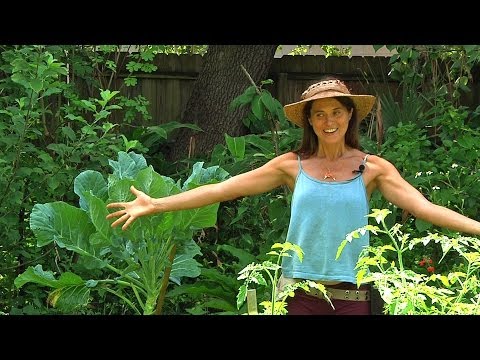
One could survive almost completely off food they grow on a 1/4 of an acre, even a 1/10 of an acre. Val Hermann, featured to the left, and her partner Eli are growing a condensed and thriving food forest on a 1/4 of an acre. I highly recommend videos of their garden, which I have posted here.
A big California suburban family is growing a food forest on a 1/10 of an acre of land. They are completely off the grid; and run their cars off of vegetable oil, eat only from their garden, and have solar panels. You can watch the video here for inspiration.
I'm not convinced there is an overpopulation problem where we cannot feed everyone. In fact few people of the world own and control the rest of the world's resources. Humans, specifically Americans, have single handedly deforested precious, sacred land for coal, gold and diamonds, palm oil, wood, plastic, oil, gas, factory farming, and the list goes on. Now animals and plants are endangered, threatening to be extinct. Water, soil, land and air is contaminated. With what little we have to share on this planet, you would think we would want to protect it, keep it clean, and cultivate more plants.
My partner and I are also working towards building a food forest. To do this, we build the soil like the forest floor. This process grows bigger, and more nutrient rich food that is resistant to diseases and pests. By mimicking the natural process of composting and sheet mulching, vegetables and fruit can be ethically grown, without killing animals, insects, microbes in the soil, without using unsustainable machines, petrol oil, and chemicals.
If the Earth's water covers 361,132,000 km2 and land covers the remaining 148,940,000 km2, water covers 71 percent and land covers 29 percent. With that 29 percent, people could be covering land with fruit trees, fruit bushes, flowers/herbs, and vegetable gardens to provide food for every person on this planet.
Lets make this happen, together~
Sunday, May 3, 2015
May garden update on Broccoli, Brussels, & Greens (plus video garden tour)
We have recently added 18 Pepper plants in two Hugelkultur mounds along with 24 Tomato plants. I would like to add some basil around the Tomato plants--that would be interesting and beautiful companion planting.
There is many more pepper and tomato plants to be transplanted. I have around 50 or so Pepper plants growing in the mini greenhouse, waiting to be transplanted in a week. There are tomato plants growing in the compost bed which we will need to transplant in a week or more.
The cold weather vegetables have started to pick up growth again, now that the cold weather has passed. The Brussels and Broccoli are large. The lettuce and spinach are doing great because they are the only young plants unaffected by the flea beetles. I have been letting the flea beetles feast on all the young plants like Arugula, kale, collards, radish, and turnips; so I will plant more of these greens as well begin picking from all the young plants to encourage new growth.
I also implemented flowers alongside some of the affected plants, which may attract large insects then discouraging the flea beetles. Well, it's an experiment at least.
Here are some pictures of the developments in the garden, as well as a video garden tour at the end of this post.


For a detailed view of the garden, watch the video below.
There is many more pepper and tomato plants to be transplanted. I have around 50 or so Pepper plants growing in the mini greenhouse, waiting to be transplanted in a week. There are tomato plants growing in the compost bed which we will need to transplant in a week or more.
The cold weather vegetables have started to pick up growth again, now that the cold weather has passed. The Brussels and Broccoli are large. The lettuce and spinach are doing great because they are the only young plants unaffected by the flea beetles. I have been letting the flea beetles feast on all the young plants like Arugula, kale, collards, radish, and turnips; so I will plant more of these greens as well begin picking from all the young plants to encourage new growth.
I also implemented flowers alongside some of the affected plants, which may attract large insects then discouraging the flea beetles. Well, it's an experiment at least.
Here are some pictures of the developments in the garden, as well as a video garden tour at the end of this post.
For a detailed view of the garden, watch the video below.
Subscribe to:
Posts (Atom)