Saturday, December 21, 2013

Plans for up-coming garden: permaculture, compost, & recycled materials

I am not sure if I will get to garden this year. My life is a little up-in-the-air. I am may relocate to another state or I am may take a walk across America with my partner. We still want to purchase land, grow food, live sustainably and such. Yet I think that may come in time.

Nevertheless, I wanted to create this post in order to organize my thoughts and plans for our up-coming garden (if I garden this year).
My idea is to plant greens and cold weather crops as early as January (I live in a cold climate). Also, I intend to plant tomato starters indoors during February, as well melons. Also, I want to begin creating small, heat trapping structures for small beds of greens, and starter plants.
My vision for our garden is building greenhouses, starting our garden earlier and earlier and incorporating permaculture techniques by using compost, leafs and brush from the woods, and other recycled materials to build raised beds. 

Faces of Modern (Current) Slavery

The holidays (November thru December) does not bring me happiness, especially since I do not believe in celebrating these holidays. Yet during this time I am with my family, which I am thankful for having. I am especially grateful that I am not these people in the photos that portray modern slavery. Slavery takes all forms, and I have compiled a stream of photos that I believe are obvious forms of slavery and the concepts that may not be questioned as slavery but what I would consider a modern form of slavery.

The images are not in order from better or worse because the concept is subjective.
A soldier ignorantly fighting for something he does not understand
Women shaving their arms to be 'attractive' or 'clean'
I have much to say on this subject. Women are considered unsanitary if they do not shave and use products to wash their hair and body. Another pet-peeve of mine is the use of disposable tampons and pads. Women who are still bleeding during their time-of-the-month should switch to reusable DivaCups or cloth pads.

Where does your chocolate, textiles, and gold come from?
 We usually do not consider slavery as a modern phenomenon, rather we consider the 1700s-1800s as a time when Africans were brought over to the South of the United States. Slavery is as prevalent today in other countries; yet we mask modern slavery with incentive (money). Chocolate, gold, and other goods are usually harvested by small children that do not get paid, instead their parents or other authority figure takes the profit.

Friday, November 22, 2013

Foraging for Wild Edibles (Fall & Winter)

Foraging is an option for a vegan that tends to live nomadic or freely. Living on the land by growing your own food may not be an option for you, so the next best way to consume free, organic food is by exploring the world around you for fruits, nuts, greens, herbs, or seeds. It is no wonder that raw foodists believe their diet is ideal because wild herbivores live day-by-day foraging for their own food.
However, foraging may be ideal for those who live in warmer climates. For example, Wild herbivore animals may not have access to fruits, greens, beans or nuts during the winter, which may lead to consuming road kill, insects or small critters (Which makes us different from animals because we have the industry to provide year-round fruits and veggies so we do not have to resort to eating animals). Of course, our forests have been destroyed of the plentiful fruit and nut trees in order to log for money, so it is also no wonder we could hardly live or thrive off the foods found in the woods in this modern day.

Thursday, November 21, 2013

Constructing our own home: cob building, homesteading, & free materials

Birds, squirrels, ants, and other species construct their own shelters out of readily available materials, like sticks, rope fiber, straw, mud, and other debris. Us, on the other hand, hire a team of workers to build our homes using drywall, wood panels, laminate flooring, paint, insulation, and other toxic and refined materials.
If you're fortunate you can build your own home; but like most of us we have to search for a vacant home at an affordable price. My mother bought home in the 90's for around $10K, and the house was built in the 1930s! It was always falling in and everything is always breaking, or pipes are freezing and breaking. 
Unfortunately, even the simplest and decent of homes can cost up to $100,000. This could take ten or 20 years to pay off.
I don't want to spend my entire life going to school for training, then working over 20 years at an unfulfilling job...


We could learn from the animals, for example building our homes for free or little cost by constructing it ourselves using the same materials other animals use.


I believe we can and should build our homes out of non-toxic, free available materials, such as the wild animals do. 'cob', 'strawbale', 'earthbag', and earthship homes are examples of how we can use readily available materials efficiently and adapt to our needs.


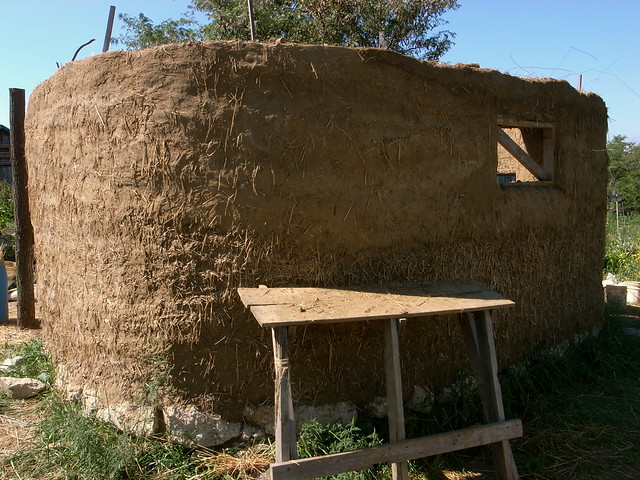
I prefer the cob (straw, sand, and clay) method because I have these materials in abundance. The ground is clay, dried grass is straw and the creeks are full of sand. I intend to create a similar construction as this couple has done in the picture below. It requires no wood for frames; and instead the walls are built up with slabs of mud, straw, and sand until you have reached the desired height. Although this method seems unsteady, it is not-- because the materials mixed creates the consistency of concrete.
The couple that built the home (in the picture), took approximately 9 months to construct and several months to dry out.
For the step-by-step process (with pictures), go to their photo album here:
"Year of Mud" The couple has several photo albums of their cob, and all natural building workshops as well as gardening photos on their Flikr page too.
 

For other references on building with cob, read "The Hand-sculpted house book" by Mike Smith, Ianto Evans, and Linda Smiley. Refer to Ianto Evan's and Leslie Jackson's book on heating your cob home: Rocket mass heaters.
 
My vision for a cob home would be somewhat of a nook. Perhaps as small as a normal sized kitchen! First the area will require leveling the ground, then digging a ditch in the outline of the shape of the home. It will be as small as a large shed, with one room to house dried herbs, books, some food, and a bed. I want a small frame that will allow us to save time on constructing the house while encouraging us to be outside instead of cooped up inside.
 
For those with no money or property, can experiment with building a debris shelter in the woods. In this case, you want to live absolutely free or temporarily in the woods, read a more recent post of mine "Semi-Permanent Debris Shelters (Minimal Living or living in the woods)" where I discuss how to build a shelter out of sticks and leaves. These debris shelters remind me of bird nests with more coverage.


bed made by monkeys


I want to live in a world where everyone views their life simply: We get our basic needs met through Homesteading (food, water, shelter) which involves gardening, collecting free energy (sun and water), and building an all natural home. Live self reliant, independent, sustainable, and free as the animal you are.


Wednesday, November 20, 2013

Smoothies v. Juices v. Whole Food (Fruit, Greens, & Veggies)

Anyone that has been a raw foodists or vegan for long-term, begins to accumulate all sorts of food prep equipment throughout the years (juicers, blenders, food processors, and the like).
The holidays are approaching, and if you celebrate Christmas with your family, these devices are some things you could ask for as gifts, if you also want to avoid buying food prep equipment for yourself. Or even better, you could buy someone a blender or juicer in order to encourage them to eat healthier.
I remember my Dad bought me a blender back in 2005 when I went vegan, and have bought several since then. My partner bought me a juicer in 2009 or '10 --which I am still using-- he got it from Walmart for $30 (GM brand). I think the 'Ninja bullet' food processors are $15 (good for blended small portions).
I am currently using a blender that I bought from Goodwill for $2.50. I am not ashamed to use a second-hand blender instead of the Vitamix! Usually thrift stores have well-priced junk to repurpose.
 

Saturday, November 9, 2013

Fall & Winter Garden Maintanence

1. Pull up remaining vegetable plants to compost.

2. Pull up remaining weeds to use in a fire on your garden.

3. Collect sticks, wood, recycled paper/cardboard (and other burnable materials) for fires on your garden. The potassium and nitrogen in wood ash helps plant growth, for example the wood ash from the fires acts as a fertilize. Having fires on your garden also breaks up the top soil, making it easier to till and loosen the soil for your Spring garden.

Sunday, November 3, 2013

Gardening Mistakes 2013 & Tips + Photos

Gardening is a continuous learning experience, from understanding your climate to the location of certain plants. Last year I wrote a piece on the mistakes I made and how I needed to improve for this year (you can read that entry here "4 Mistakes I've Made as a First-year Gardener").

I have compiled a whole different list of the mistakes I made as a second-year gardener below. In the list I highlight the methods I intend to use next year and other practices...

Friday, September 20, 2013

Time to start saving seeds (& dehydrating/storing garden harvests for winter)


The past two months have kept me busy, replanting lettuce (for Fall) and harvesting, storing and dehydrating excess food. My tomato garden produced over 200 pounds of fruit this year so my partner and I have been feasting on large quantities of tomatoes. Yet, we couldn't eat them all, some went to the compost and some tomatoes ended up getting canned and dehydrated.

dehydrating tomatoes with basil from the garden
tomatoes ready to be eaten fresh or dehydrated


Sunday, September 8, 2013

Garden Harvest & Grocery Hauls (Raw Vegan budget)

**The photos are produce hauls from my garden harvests including fruit from the grocery store**

The Snicker's tag line You're not you when you're hungry speaks volumes to those who tend to be short-tempered or irritable. Another saying I often use an angry man is a hungry man suggests that a starved individual is a starving brain (i.e. irrational thinker, temperamental, binges on junk food).

peaches, peppers, and tomatoes from my garden;
plus mangoes, bananas, watermelon, and Asian pears

Monday, August 26, 2013

Fall Garden: What to grow during August-October in Zone 6 or other cold climate regions

We are moving towards September, and there are many vegetables you can be growing during this time. This week is a perfect time to plant salad greens and root crops. Bush beans can also be grown. As you can see from the first photo below, I currently have red leaf lettuce and kale growing in a small space (where I grew the broccoli this Spring); plus a teeny-tiny row of peas. I, also, planted collard greens in a bucket, and three other varieties of lettuce (buttercrunch, iceberg, and romaine).

Moreover, I am experimenting with the growing space. Instead of long narrow rows, I have planted the lettuce and kale in short wide rows.


progress after planting lettuce and kale two weeks ago

Wednesday, August 21, 2013

Garden updates & Harvest photos (& what to plant during summer to fall season)


I have harvested 100 lbs of tomatoes from June to August,
approximately $150 if I bought this at the grocery store


what to do with all of these tomatoes???

Perfect for raw soups, salads, juices, dehydrated, and more


my partner and I have been eating lots of stir-fry, soups,
and salads with these ingredients


Growing a small scale garden has allowed me to eat lunch and
dinner from my garden, everyday for the past two months


zucchini, cucumbers, okra, and squash

last of the tomatoes and peppers of the season
Garden harvest & grocery haul with mangoes, bananas, and avocadoes

9 Organic cucumbers from the garden is the
equivalent of $8.50 if bought at a store

harvest of cucumbers and peppers (the equivalent  of$15)


Estimates $6-7 of arugula, from the Spring garden

lettuce & green onions

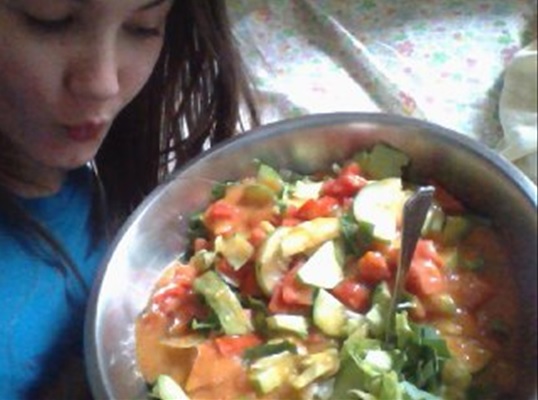
Most of the meals I've made with my garden veggies have been salads. The most simplistic and tasty salad is a combination of chopped cucumbers and chopped tomatoes (with a little avocado) over a bed of lettuce. I use three cucumbers and five tomatoes to make a large salad. I will also chop tomatoes and cumbers over a bed of lettuce with a sauce made of blended mango, tomatoes, zucchini, banana and jalapeno peppers, and dill from my garden (you could also add some avocado to the sauce).


Cabbage, tomatoes, cucumbers, peppers from the garden 
with mango and avocado.


Another dinner for me is a typical fruitarian soup: mangoes and tomatoes.


Thursday, July 25, 2013

What vegetables to grow during the summer (May, June, & July)

Hello everyone! It has been several months since I lasted posted. Obviously, I have been keeping busy in the garden: hoeing, weeding, staking tomatoes and beans, and planning my Fall garden. I have also been remodeling my youngest brother's room (which has taken several weeks of my time.) Also, my Mother is working on her Masters, so I've been involved with helping her write essays. Moreover, I wanted to make sure I was able to reconnect with you all, and detail what I have been growing in my garden.
 
Within a couple of weeks I will do another entry that will list NEW practices I have learned as a gardener and highlight the mistakes I made this year that I will improve on next year. You can check out what I learned last year from my first time gardening, here "4 Mistakes I've made as a First-year Gardener"
 
To see what I have harvested in the last four months from these gardens, please visit: Garden updates & Harvest photos (& what to plant during summer to fall season) and "You're not YOU when you're hungry". You'll be surprised how much you harvest with little growing space.
 
Furthermore, the intention of this entry is to show you what I am currently growing and harvesting from this Summer's garden, and what food I was able to harvest from my Spring garden. Hopefully these pictures will inspire you to grow a Fall or winter garden, or perhaps inspire you to plan your spring and summer garden for 2014...Enjoy...


Basil, parsley, sage, and dill

Basil


Northern (white) beans

northern, kidney, pinto, and lima beans and black eyed peas

Beet greens


Broccoli/cabbage patch
Broccoli from spring garden...very delicious!


Broccoli head


butternut squash


Corn/okra/tomatoes
corn and okra

 
green peppers

hot peppers


rain barrels

 
lettuce, arugula, and spinach going to seed (the weeds have taken over!)
My partner and I also have a large watermelon and cantaloupe patch, but the location was not ideal. Melons need sandy soil, which I could not simulate for them this year. Perhaps next year I will ask a generous farmer if I can grow melons near his creek bed. Also close by the squash and melon patch is a large cucumber patch which is producing great! I'm eating lots of cucumbers and squash every day from my garden in the last two weeks. Being vegan is easy and inexpensive when you grow your own food!


zucchini/yellow squash/pumpkin/butternut squash patch
zucchini/yellow squash/okra


strawberry patch with 1 year worth of compost and pine needles

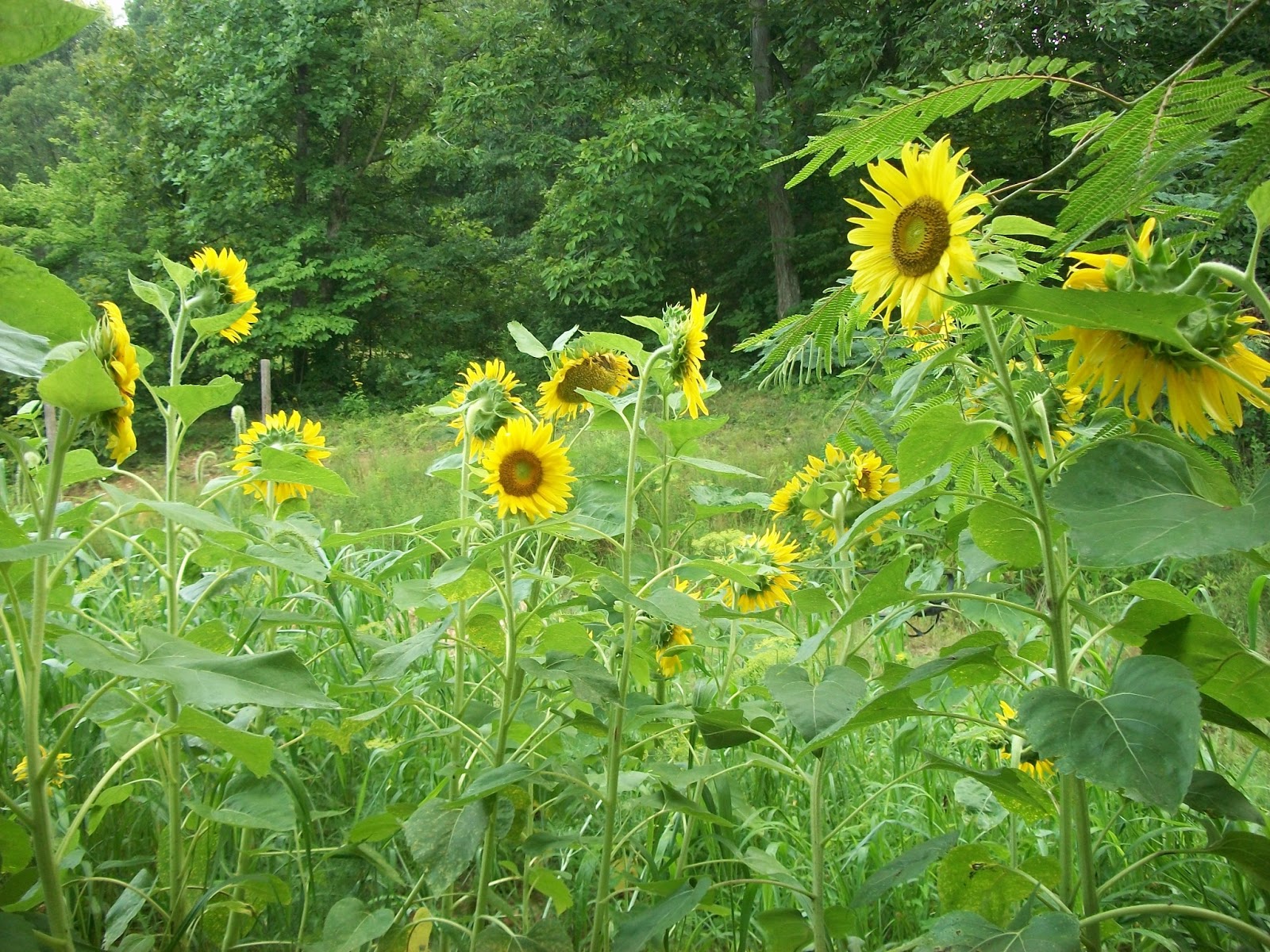
sunflowers...can't wait to eat the seeds!


tomatoes from our compost

tomatoes from a generous farmer


100+ tomato plants

"What are you going to do with all of them tomatoes?" says the meat-eaters

Sun-dried tomatoes, tomato juice, tomato soup, tomato salad, tomato sandwich - so many options!