Tuesday, February 21, 2017

Give people land (Redistribute land!)

knowledgeisking.ning.com
In this essay I discuss the historical ways land and resources are taken away from people while they are exploited for corrupt means. Our history has created systematic disadvantages for the poor people of color. This system is environmental racism-- where the poorest persons of color are segregated and red-lined into the worst schools, worst neighborhoods, and worst environmental conditions. Another example of this environmental racism includes deforestation in Central Africa (Congo) and South America, and pollution/contamination (e.g. Flint water crisis) affecting poor people and people of color, on a global scale (an international division of labor).

Consequently, not many people know of the United States' terrible history of buying up land and exploiting it, nor do people know the extent to which this affects the present state of affairs. One thing that impacted the most was Land lotteries which prompted Indian removal. Land lotteries was simply giving away land to white immigrants like in Georgia. Another impact was creating systemic racism in the form of African/African American slavery. Even after slavery, Black families were not allowed to get loans to make small payments on property, Blacks were segregated, and now there is a phenomenon now that keeps Blacks segregated called Redlining. There are many systematic factors that contributed and still contribute historically to the racist policies, laws, customs, mores, etc which keeps people of color from owning land in the United States.

Those in rural areas were greatly disenfranchised during the Industrial age in Appalachia because of coal mining and timber companies. For example the expansion of surface mining leveled thousands of acres of mountaintops because the coal industry benefited from mountaintop removal (Eller, 2008.) Additionally, corporate chains like Wal Mart affect small local businesses in those rural areas of Appalachia, especially when the profits do not trickle down into the community because they go out of the region. The Appalachian Land Ownership Task Force found that large corporations and land companies controlled up to 90 and 100% of the surface land and the mineral resources in 80 Appalachian counties (Eller, 2008.) This was a significant study during this time and it's shocking information. Other data the study found was that 8 million acres—more than 40% of land surveyed—was owned and operated only by 50 private owners and the federal government (Eller, 2008.) 

Another example of this is that for 14 West Virginia counties, 25 companies owned 44% of the surface land, yet only assessed for 20% of the area’s taxes (Eller, 2008.) This means that taxes from these large corporations are not going to the community while the poor community pay higher taxes or more taxes to support it's own community. Likewise, these systems of racism has led to the extreme wealth of a select few white families. Today, the median wealth of white families is 20 times greater than the median wealth of black families (and 18 times greater than Latinx families). 
Subsequently, some of the programs put in place to aid those disadvantaged did nothing to help disadvantaged people of color. In fact, FDR was able to pass the New Deal including Social security and other beneficial programs, as long as they excluded domestic service workers and agricultural workers (which meant predominantly people of color.) This gave preferential treatment to whites. Secondly, the dream of home ownership granted mortgage loans to Americans, where 98% of all recipients were white. Third, GI bill was passed to give low cost mortgage, living expenses paid, and paid tuition for veterans, which exclusively benefited whites, and excluded black veterans. 
Additionally, The 62 of the richest billionaires own half of the world’s poorest populations. Those that have accumulated all the world's resources simultaneously destroy natural resources at an alarming rate. Those richest people are the ones that destroy the land (trees, soil, crops, air, water, animals/aquatic life), those people buy all the land, and try to keep people from being truly free. We do NOT live in a free and equal opportunity country, and it is essential that we (the 99%) take back stolen land, take back our stolen creativity and individuality. In an effort to save, protect, and preserve nature and all its species, we cannot continue to deforest the planet, pollute, and kill off ecosystems.


Moreover, the middle class own more land, but it's usually for farming, growing soybeans or corn for livestock to eat, or for hunting grounds (more family owned operations). I'm not sure how anyone figures they own the oceans, but they also wreak havoc on that too, and capture to exploit and kill aquatic life. Those who own the majority of land on this planet are the rich who exploit it for drilling and fracking, mining, infrastructure, etc. In fact the families who own most of the world's resources are the reason the number of trees has fallen by 46% since the start of human civilization. There are over 20,000 different kinds of trees in the world. Actually, 3 trillion trees are left on the Earth. Somehow these same people who don't own land will go to different countries in Africa or South America to mine for gold. And they too are part of the destruction of land, trees, wildlife, and the last remaining tribes.

As mentioned, all of these examples are the many ways land and resources are taken away from the poor and persons of color, and consequently, this land is often used for big business, corporations, coal mining, logging, or fast food chains. What's truly depressing is that absentee owners of land have taken thousands of acres while rich families keep land in the family for to be passed down through generations. I'm not sure redistributing land (redistributing wealth) is feasible, but it sounds effective. And in fact when I think about the few people that own half of the world, this wealth disparity is unfair, and simply unjust. This cannot be normal, this cannot be how the system works. There is much land to be "bought" but there is much land already owned on a large scale.

Simply, if all people were given land to build their own houses and grow their own food, there would be less corporations, less logging, mining, fracking, pollution, etc. If all people had an acre, no one would want to cut down all the trees on their property for a quick buck. People would perhaps use their land to make a home business and then this would create a local economy where everyone had a service to offer. This isn't about poor people paying taxes, because in fact the tax system is not fair for the poor to begin with. Poor people shouldn't pay taxes, only the rich! Poor people pay the same tax rate as the rich, if not more taxes. And something most people don't realize is that half of the US budget goes to funding the military. So, clearly the tax system is not fair for the poor, but it should be used to regulate the rich because they are clearly exploiting people, resources, polluting land, and those are the people that came from money that was passed down to them through the generations of a system that favored the imperialist white supremacist capitalist patriarchy.
 
I am one of the many people who do not own land. Even if I bought land, I still do not "own" any of the trees, the sky, the birds, the deer, the soil, rocks, and rivers. People often talk in terms of ownership like "my girlfriend", "my daughter," "our Earth", "our galaxy", "my America." I find this to be problematic because this suggests that we have a culture that cannot look outside of capitalism, imperialism, and colonization. I fear that if the culture continues to use rhetoric that reflects ownership and possession, then it will be one where the disparities, inequality, destruction will be even greater as civilization ages within this world. But, if those of us don't collectively buy up land to take away from capitalists, then what will be left for those of us that want to protect it? True equality is the providing access to healthy living conditions, healthy food and land to grow food, and education for everyone. 

References:

Eller, Ronald. D. (2008). Uneven Ground: Appalachia Since 1945. Lexington, KY: University of Kentucky Press.

Rosenberg, Matt. (2016). Refugees: The Global Refugee and Internally Displaced Persons Situation. ThoughtCo. https://www.thoughtco.com/global-refugees-overview-1434952

Re-wild yourself Part II: Hike in the woods naked


The Hyacinths are popping up, along with the tulips, and daffodils and crocuses have already presented themselves with their delicate petals. On a day like today where it's a overcast, 70 degrees in Kentucky in late February, I find that it's the right time to rake up some brush around the flower
bed so I can mulch soon.
But also on days like this, I go into the woods to my sacred spot that I have dedicated to meditating and sunbathing. Here in the woods I re-wild myself when I take off my shirt, pants, briefs, and boots. My bum is bare to the smooth cold rock shaped perfectly like a bench. The tree above me has its roots wrapped around the rock where my feet are dangling and I'm rubbing my soles on the smooth bark of the Elm. A Hawk calls above me and circles the hillside. Other birds make cute little playful sounds like they're saying yes to the coming Spring. And I spread my body like the flowers emerging from the soil, stretch like the tree, arms out like the hawk, and the fungus growing.

In my previous post on Re-wilding yourself talked about eating wild edibles and some common wild edibles in the woods near you. So I wanted to share with you another way I re-wild myself often throughout the year. Because there is something pleasurably freeing being naked in the woods, I also suppose this experience makes me feel hat like I am reverting back to my animal. I feel that this practice is like therapy in that way.

 I must say that it is a privilege to have access to woods, forest, trees, grass because in urban areas, it's an industrial waste site. And I'm even more privileged because I have woods behind my house. But, try this practice of hiking naked in the woods if you have woods near you, and document your feelings and reactions. There are many things you can add to your meditation practice like standing erect with your back against a tree and holding the base of the tree like you're giving a reverse hug and imagine and exchange of energy being transferred between you and the tree. I tried this today as well and I found it very comforting and healing. So experiment with those holistic practices as well as see if they work for you. Many people require some form of rejuvenating or healing period in their life--and some people call it a vacation--but I tend to create my own retreat when I go into the woods.

Wednesday, February 15, 2017

Indoor Starter Plants with LED grow lights (Mid-February 2017)

Below are updated pictures of the indoor starter plant garden. I have LED 4 foot lights attached to two rubbermaid shelves. Growing on the top shelf is Swiss chard germinating in recycled strawberry/blueberry/kiwi containers. I buy a seed starting mix, or will mix my own potting soil with vermiculite, perlite, and peat moss. On the second shelf is Cherry tomatoes and Beefsteak tomatoes growing almost directly under the grow lights.  The tomatoes were sown 6 days before they sprouted, and now they are at least an inch tall. Beside the trays of tomatoes are a Goji berry in the orange pot and a Pineapple plant to the right. Below on the 3rd shelf is another goji plant in the orange pot with a tray of onion seed germinating, then Beets, lettuce, Artichoke, Brussels, Broccoli, and Cauliflower growing in the second (middle) tray. To the right is a tray of Radish growing. The radish are becoming quite leggy despite putting them directly under the grow light like with the tomatoes.


Cherry Tomatoes

Radish (right)

Goji berry

Goji berry

Wednesday, February 8, 2017

Indoor Growlight Starter Plants & Greenhouse in Early February (Winter)


In the Indoor garden, there are LED grow lights above the starter plants (seen above). Some of the plants sprouting are radish, lettuce, broccoli, and beets (seen below). Those that I sowed are Onions, Beefsteak and Red Cherry Tomatoes, Artichoke, and Cauliflower.


Basically I turned the porch into a greenhouse to keep the outside animals warm in the winter. And of course it works as a place to start cold weather crops in the late winter and early Spring. Below I took pictures of the greenhouse I assembled using materials I had on hand. Because it was warm for the last two days in Kentucky, I put the tropical plants outside in the greenhouse. You may have seen in the past that I have Pineapples growing, as well as Snake plant, Aloe, and Cactus. The tropical container garden is dwindling considering the inside and outside cats tore up many of them or "fertilized" the plants to the point that they killed many of my indoor plants. But of course I am collecting and growing more.


Thursday, February 2, 2017

What's growing on in the Winter Garden 2017

Now that Spring is closer upon us in the US, I'm cleaning up the garden mounds to be mulched soon. Today I'm starting some seeds indoors in my mini greenhouse with grow lights. Some of the plants I will be starting is a Artichoke, Lettuce, Brussels, Cabbage, Broccoli, Cauliflower, and I want to pick up some Radish seed to start growing them early indoors. Then towards mid-March or early April I will transplant these in the garden. Before I transplant though I want to have composted and mulched the mounds and made polytunnels to protect the plants. Afterward that point, I will start Tomato and Pepper plants indoors to be transplanted in May. I hope to have mulched and composted the mounds for these plants, then in May I will directly sow Squash, Melons, Gourds, and other things in the garden.

As of now, I have been growing a couple of rows of Arugula, Collard greens, lettuce, and carrots in the Hugelkultur garden. There is some cilantro and Red Russian kale growing among the greens as well. Because here in Kentucky the winter has been mild, the greens have been growing with little protection from now in the beginning of February from September. All I have used to protect the greens from the cold and snow is cloth row covers like garden canvas. I have been able to have greens to eat in salads or eaten fried. I also harvested a couple of carrots that I noticed were a decent size to pull up. Today I had a surprisingly long carrot that was growing in one of the garden mounds. Below are photos of the winter garden and the carrot harvested today.

collards
 
collards

lettuce

carrot harvested
row of Carrots

row of Arugula & Collards


Wednesday, February 1, 2017

20 Little known garden facts

(1) black walnuts put off a neurotoxin known as juglone which inhibits growth for surrounding plants.

(2) tomatoes are perennials, however they are short lived perennials. Most farmers/gardeners cultivate tomatoes as an annual.

(3) bananas which contain potassium act as a nutrient & fertilizer when mixed with mulch around plants/trees.

(4) Bamboo is the fastest-growing woody plant in the world; it can grow 35 inches in a single day--which makes bamboo a great resource for garden projects such as trellises. also commercial use of bamboo would ease the destruction of the old and living trees.

(5) During the 1600s, tulips were so valuable in Holland that their bulbs were worth more than gold. The craze was called tulip mania, or tulipomania, and caused the crash of the Dutch economy. Tulips can continue to grow as much as an inch per day after being cut.

(6) Small pockets of air inside cranberries cause them to bounce and float in water.

(7) Peaches, Pears, apricots, quinces, strawberries, and apples are members of the rose family. So are ornamental species such as spirea, mountain ash, goatsbeard, and ninebark.

(8) Peanuts are not nuts, but legumes related to beans and lentils. They have more protein, niacin, folate, and phytosterols than any nut, according to the National Peanut Board.

(9) Nectarines are actually peaches that have a recessive gene that makes them grow without the fuzzy skin. They are not actually a different kind of fruit.

(10) There are more microorganisms in one teaspoon of soil than there are people on earth.

(11)  Plants respond to sound and in fact react by growing better when listening to soothing music and other sounds, but reacts and grows slowly or stunted when plants "listen" to hard, loud, and chaotic music.

(12) A sunflower consists of 1,000-2,000 individual flowers where the fuzzy brown center and the classic yellow petals are the individual flowers held together on a single stalk.

(13) Baking soda sprinkled regularly around tomatoes in the garden can reduce the acidity and make the tomatoes much sweeter in taste.

(14) Hydrangea flowers color can be altered by the pH level of the soil. For example, a more alkaline soil will result in pinker blooms, while a acidic soil will produce blue blooms. To facilitate a blue color, add more organic matter to your soil, like coffee grounds (though the acidity in used coffee grounds can vary greatly, so you might try a high-acid fertilizer, too). The change won't happen overnight, but eventually you should succeed in manipulating your soil's pH level.

(15) Archaeologists have uncovered evidence that grapes were grown to make wine about 8,000 years ago in Mesopotamia (today's Iraq), although the ancient Egyptians were the first to record the process of making wine about 5,000 years ago.

(16) The first potatoes were cultivated in Peru about 7,000 years ago.

(17) The average strawberry has 200 seeds. It's the only fruit that bears its seeds on the outside.

(18) Trees are perhaps the longest living organism on Earth. Ginkgo (Ginkgo biloba) is one of the oldest living tree species; it dates back to about 250 million years ago. Dawn redwood (Metasequoia glyptostroboides) is another ancient species; it dates back about 150 million years. Both were known in the fossil record before they were found alive. The world's tallest-growing tree is the coast redwood (Sequoia sempervirens), which grows along the Pacific Coast of the United States, mainly in California. Interestingly enough, it's not the world's oldest-growing tree; that award goes to a bristlecone pine (Pinus aristata).

(19) Figs were the first domesticated crop in the Near East about 11,400 years ago!
Archaeologists found carbonized figs in a village north of ancient Jericho, and compared the fruits to modern specimens. Through this comparison, they determined that the fruits had been intentionally propagated.


(20) Earth worms have the power to move stones that weigh 50 times their own weight. They love coffee grounds. They ingest soil and organic matter equal to the amount of their body weight each day. They also help with your compost pile; when you turn your compost pile and find a lot of earth worms, you know that your compost pile is working and that you will have great top soil for plants.

Monday, January 23, 2017

Gardening economics: The Top 3 Questions I get asked

Often when I exhibit my garden harvests, people immediately start asking me how much I spend each year on gardening supplies, how much food I produce, and how much land I'm working with. These questions will be answered here, and I hope this is useful to all those that are curious and want to work with their own slice of land to grow food where ever and when ever.

1. How much do you spend on your garden every year?

Typically every year in the Spring, I buy $20 of mulch which is a truck load, and I spread that on the garden to start transplanting seedlings. Sometimes I will end up buying another truckload up mulch at the beginning of Fall for the fruit trees, so that will come to $20-40 in mulch every year. Then of course because I plant a lot in containers, I usually end up buying $30 in garden soil or potting soil. As for seeds, I typically do not need to buy seeds because I have been saving seed from my own crops for years, and I hoard seeds for the following year, so I don't usually spend any more than $20 on seeds. Although for the first couple of years I was buying $50-60 worth of seed to start my Non-gmo organic seed collection. And I always buy some plants at the nursery to get started early such as brassicas, tomatoes, or peppers that often take a long time to grow for a regular gardener, so I will spend no more than $20 on a certain type of plant every year. With all that factored in, I will usually spend approximately $90-110 total every year.

2. How much food do you produce?

Actually this is very hard to calculate because the foods I harvested were organic, some wild edibles, and some foods that are very unique that they may be quite expensive. For example, the figs that I grow and harvest, I'm not sure what they would equate to be because I have never been to a grocery store that sold fresh figs like they do in California. To calculate how much food I produced last year, I skimmed some harvest photos, and I would estimate that I grew over $400 worth of food.

Actually, this is a low estimate because like I said, I grew lots of fruit that I have nothing to compare the price to, especially the wild mushrooms I picked. In fact, I grow unique fruits and vegetables that add value to the garden. To get an idea of a big harvest for me in the garden, below I have posted photos of my garden harvests for the last couple of years:

2013

minus the peaches! 2014

2014

2015

2015

2015

2015

2016
Because I'm calculating last year's garden harvest, I actually got back less because I didn't garden as much last summer as I have done previous years where I've had help. In previous years without growing and harvesting peaches and figs and wild mushrooms in the garden, I was growing $1000 every summer in squashes, greens, tomatoes, and peppers. 

3. How much land are you working with?

In previous years I have been permitted to use my grandparents' gardens that they grew on for decades, and now I have taken it over to use. I'm not quite sure what the footage of this garden is behind their house, but I will estimate that it's a 60-70 foot long garden and 15 foot in width. The garden in front of their house that I have been using is a little smaller, but still a lot larger than the garden at my house. This one is probably 50 feet in length, and the garden I work with at my house (on my mother's property) is perhaps a little more than 40 feet in length. On my mother's property (which is 0.6 acres), I grow fruit trees all over the garden and around the house. There is over 14 fruit trees on the property (cherry, plum, peach, nectarine, pear, figs), and over 20 fruiting bushes (blueberries, grapes, raspberries, aronia, blackberries, goji.)

Of course, not everyone has even the small amount of land I'm working with, so I want to mention that I have many posts on growing in containers indoors, and growing food as an apartment dweller, so I recommend reading those posts if you're an aspiring gardener that does not have their own land yet. Here are some suggested posts to visit for apartment dwellers:

Grow Veggies & Fruit trees in Containers (Limited Space & Urban gardening)

Recycled Bucket Gardening (container gardening for apartment dwellers)

1200 square foot apartment garden

Scary truth about PLASTIC: The ocean is a plastic soup

The ocean is a plastic soup. Plastic is derived from synthetic materials, most commonly produced from petrochemicals, and we have become devastatingly dependent on this "material", and the environment is reaping this destruction. "In some cases, small amounts of those chemicals can remain trapped in the product unless suitable processing is employed. For example, the World Health Organization's International Agency for Research on Cancer (IARC) has recognized vinyl chloride, the precursor to PVC, as a human carcinogen" according to McRandle of "Plastic Water Bottles". National Geographic. BPA in plastic has been argued to be an estrogen-like endocrine disruptor that may leach into food (McRandle, 2004.) "The very chemical bonds that make them so durable tend to make them resistant to most natural processes of degradation."
In fact, what happens to a lot of plastic is that it drifts from landfills and populated areas into the water ways. The documentary Plastic Paradise: The Great Pacific Garbage Patch shows you footage of their own discovery of what plastic does from netting entangling coral reefs to pieces of plastic eaten by seabirds. In the documentary, the research states that often the people that use netting for fish will leave the net in the ocean. In one instance, one sperm whale found in California in 2008 died because it ingested 22.2 kilos of plastic in its lifetime. 

Because plastic is relatively low cost, "easy" to manufacture, versatile, and resistant to water, plastics are highly valued by people. According to Andrady of "Applications and societal benefits of plastics" says "packaging beverages in PET plastic rather than glass or metal is estimated to save 52% in transportation energy". While this may be the case, I am advocating for a an entire shift away from pre-packaged beverages and things altogether. Yes, that sounds like I do not want to buy anything at all, and that sounds very strange to people to imagine a world where things aren't wrapped or packaged, or that things wouldn't exist at all. That is the concern for people.

According to The World Counts, global plastic waste has created a gigantic “plastic soup” the size of Russia in the Pacific of up to 15 million square kilometers. In 10 years, this amount will double. This year alone, we will be producing 5 trillion plastic bags, equating to 160,000 every second. All of us are guilty of this plastic convenient bag. But for the last 6 years I have used cloth bags every time I go to the grocery store so I'm not using plastic grocery bags. Of course when there is an occasional plastic bag that ends up at the house, I use it for the bathroom trash (I may do a video or a post on what I do with plastic bags in the future.)


Even on my behalf, I have limited the amount of trash and waste I produce and throw away. For years I saved plastics and took them to the recycling place, but realized: this is only adding to the environmental degradation--it's fueling the fire, so to speak. I save cardboard boxes to burn later, I save glass bottles, and other things so I'm not throwing them away. I realize though that I'm surrounding myself in trash and waste as to avoid adding to it to be dumped elsewhere.

This is a consumer culture, thus it is a trash culture too. There are small and large scale solutions, and all we have to do is imagine we can do it because humans are very good at imagining the future and creating what we want to see. I believe that we can abolish the plastic industry and completely change the way we make everything. It is a matter of seeing the problem, because especially in the case of trash and waste, if someone picks up our trash to take it to a landfill, we are not aware of the devastation we are doing ourselves. We don't watch our trash get taken to a landfill and watch our own trash get tossed and parts move with the end, and things end up in the ocean. If we see the problem, we will want to fix it.
I have mentioned this before in several posts: that instead of logging trees and clear cutting forests for carbon materials like box, loose leaf paper, and many other things, we can use hemp or bamboo instead because they are low impact materials. This can be said for plastic as well, by replacing plastic with hemp fibers.
banthebottle.net

People think because bottled water exists, that somehow it's better than tap water (although I find that tap water tastes like bleach, I still drink it instead of bottled water.) But, more people are buying different beverages in plastic bottles, and of course when you give people so many options, they help these corporations get rich.
Once again, individual solutions are good, but there will need to be large scale change that requires corporations to refuse buying and using plastic while completely changing the way they package items. Or even better, these corporations realize that what they produce and sell is meaningless to life, adds to the trash and waste of the world, and realize that they only produce things to make money instead of creating everlasting change. Actually, the large corporations need to be held accountable for all the unhealthy food and beverage options and the waste that exists in the world--we cannot blame people for their own mindless gluttony because it's the rich that are exploiting that notion of people.
There are many micro and individual solutions, like Sweet, a company that takes travelers to destinations like Mexico, that they call 'gaycations' to clean up the environment and do many community service projects during their stay. I found that to be interesting and mindful, so I recommend watching the full video here for some inspiration.

Friday, January 20, 2017

Scary truth about America's diet (food waste & unhealthy food consumption)

According to Ecowatch:"90 percent of the foods humans eat come from just 30 plants. Out of tens of thousands of plants we could eat, mankind chooses to consume only about 30 of them. It’s crazy to contemplate how limited our diets are compared to all of the different foods we could be eating".
A diet of 30 plants that humans consume is less worrisome that Michael Pollan's argument.
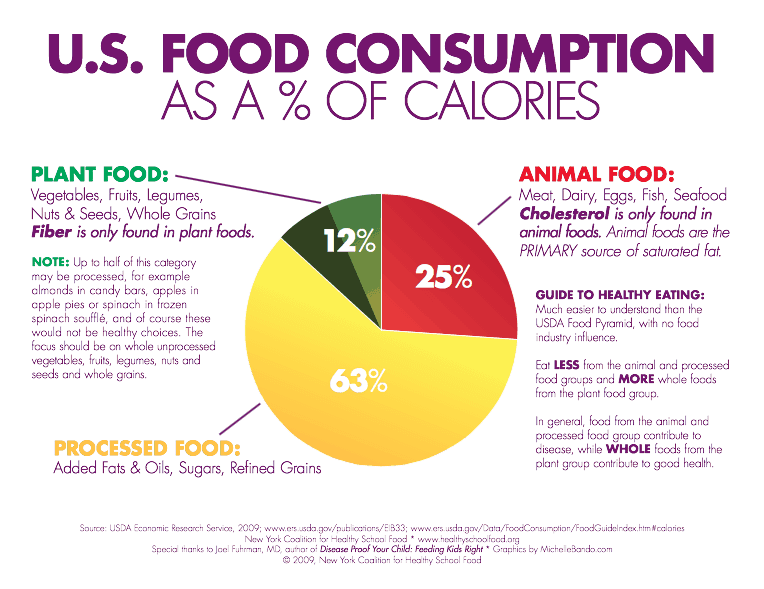
As mentioned in my post on re-wilding yourself with wild edibles, Michael Pollan has much to discuss on this subject. Pollan in In Defense of Food, says that the majority of American's calories come from 4 foods: wheat, sugar, soy, and corn. However he also mentions that another big portion of the calories come from dairy and meat products as you can see in the pie chart below from Food is Medicine.

US Food ConsumptionMany health gurus tell you to eat simple, and this makes intuitively like eating an apple. I consider my diet simple as far as eating a large variety of fruits, vegetables, greens, grains, beans, nuts, seeds, but this means that I'm get a variety of vitamins and minerals. The kind of simplification in the typical American's diet is excluding these health foods for diet that is simplified to a handful of the same ingredients for every meal with a different arrangement of those ingredients.


Let me be clear: I do not fault an individual for the availability and price of unhealthy processed foods. Actually, there is much to say about the way food is distributed such as grocery gaps where urban and rural areas have to travel up to 20-50 miles to get a grocery store. Considering this, there are family dollar stores, gas stations, and liquor stores in close proximity to the poor urban and rural regions of this country. I can protest all day to avoid putting your dollar in these big corporations that are making you and your family unhealthy. And let me also be clear: just because your skinny, doesn't mean your healthy; and just because you're fat, doesn't mean your unhealthy.
In considering all of this, who do we look to that created this unhealthy industry? Do the CEOs and head management eat the crap that they sell in stores? Does Doritoes eat Doritoes? Do these people that run the corporations let their children sit in front of the TV and watch the food ads they put on TV to brainwash children?
It's similar, but not quite the same way cigarettes are sold. There is a warning label on cigarettes, but the only labels on packaged foods are those that are deceiving you into thinking it's a health food. Healthy food is a whole food like fresh fruits and vegetables.

The limited ingredients in a diet is just the least of our worries, because a much more pressing issue is that 40% of U.S. food is wasted, equating to $165 billion a year in waste according to CNN. This means that there IS enough food to feed the world, and the problem isn't an expanding population where the globe cannot produce enough food for everyone. This is another problem with corporations: they're producing too much food, and distributing too much food in the most consumer-heavy regions. Of course packaged food has a "long shelf life", which basically mean there isn't any nutrition left. So, let's consider what food is wasted the most. I worry, though, that when people do attempt to eat fruits and vegetables, this food typically goes to waste. 
 As mentioned, packaged food that can be preserved with a longer shelf life than fresh, raw fruits and vegetables, is a mixture of those same ingredients of meat, dairy, wheat, corn, soy, and sugar. Because these foods are highly processed, thus their raw, fresh form loses the nutrients and minerals that once was there before the processing. The solution to unhealthy food consumption and food waste isn't to grow more, sell more, or donate more. The solution lies within the power structure. This may sound like a radical idea, but by giving people and families their own land to grow their own food will be part of the solution.
This further angers me because there is the safety of pesticides and GMO foods argument that we need these technological innovations to ensure we have enough food and no money is wasted--well, isn't that a laugh when we consider that people deliberately are wasting food, and corporations continue to over produce and over sell foods. Not only is food wasted and chemicals used becomes unnecessary, but fuel and transportation become wasted. And lets get real about the land we use for what: where we have hundreds of acres of wheat, corn, and soy being grown exclusively for the fattening of cows, chickens, pigs, and animals to get fat on their unnatural diet in order for humans to consume them.

Of course there are many solutions, but we cannot keep making the same mistake of selling and growing more, because the problem is where the food is getting distributed, as mentioned by National Geographic: "the richer the nation, the higher its per capita rate of waste." National Geographic also states that: "To compound the environmental insult, food buried in the airless confines of dumps generates methane, a greenhouse gas far more potent than carbon dioxide. If global food waste were a country, it would be the third largest generator of greenhouse gases in the world behind China and the United States."
 Restaurant buffets are notorious for food waste. In fact the other day as I watched my mother and sister eat at a Chinese restaurant, we examined a family that continued to get food from the buffet that they ended up leaving there to be thrown away. My mother, sister, and I were furious at this, to the point we wanted to take the food (because we watched, and the food wasn't touched). 

Additionally, we have to refuse a global food corporation like McDonalds taking over America,  India, Asia, and Africa. We got to refine the food market, but the food shall not be refined! 
The solution is not necessarily individuals taking their business elsewhere, it is a matter of a culture shift and changing our perspective about the kinds of food we want to sustain the planet that works with this planet.

Common Tomato Plant Ailments & Pests


Original post @ Organic Tomato Garden Tips to read full article, in addition to Using Hydrogen Peroxide with added information.

Early Blight

"Caused by a fungus Alternaria solani, early blight is also known as target spot or alternaria leaf spot. Signs of early blight are loss of leaves on the lower part of the plant and brown or black spots that are 1/4 to 1/2 inch in diameter that appear on lower leaves. Spots often merge and form odd-shaped blotches and may look like a target. Leaves will fade to yellow and dry up. Early blight often attacks the tomato as well, leaving large black concave areas on the tomatoes. Warm damp weather helps spread early blight. Fungicide is used to control early blight. Follow manufacturer’s instructions when using any fungicide on your plants.
Verticillium Wilt
"The fungi Venticillium albo-atrum and Verticillium dahlie are the cause of verticillium wilt. Small yellow patches appear on the lower leaves of the plant and, eventually, as the disease spreads upwards, leaves turn yellow, wither and drop. Verticillium wilt also causes the internal browning of the stem near the soil line. Infected plants can survive but their growth is often stunted and their crop yield is lower. Controlling verticillium wilt is difficult; no fungicidal treatment has been effective. The best way to prevent verticillium wilt is to choose tomato plants that are not susceptible to the disease. Look for tomato plants or seeds that are labeled “V” for verticillium-resistance. The Better Boy, Big Beef, Roma and Early Girl are a few varieties of tomato that resist verticillium wilt."

Bacterial Spot

"Bacterium Xanthomonas campestris pv. vesicatoria causes bacterial spot. This disease appears as brown spots on the leaves and stems of the tomato plant. The splotches are about 1/8 inch across and feel slightly slimy to the touch. As the spots begin to grow they often appear to be surrounded by a yellow halo. Once spots become abundant, they will grow together and cause the leaves to turn brown and wither. Bacterial spot can affect the fruit of the plant. Black dots will appear on the tomato and will enlarge to 1/4 to 1/2 inch in width and become sunken, gray and scab-like. Keep areas around tomato plants weed-free to help reduce the chance of bacteria growth. Fungicide is effective in controlling bacterial spot. Follow manufacturer’s instructions when using fungicides on your plants."

Bacterial Canker

"Plants infected with bacterial canker often appear to have the disease on only one side. Eventually the disease does spread to the entire plant. Caused by a bacterium Clavibacter michiganesis subsp. michiganesis, bacterial canker can cause extensive damage to your tomato crop. Young plants will suddenly wilt and older plants will experience browning along the edges of their leaves. In rare occasions, the stems of the plant will develop cavities or brown cankers. Raised white spots may occur on tomatoes, sometimes called birds-eye-lesions, and the white spots will turn brown as it ages. Control bacterial canker by planting disease-free plants and keep areas weed free to reduce chances of bacterial growth. Copper spays have little effect on the bacterial canker and, most likely, will not stop the spread of the disease".

Septoria Leaf Spot

"Septoria leaf spot is caused by Septoria lycopersici. The first symptoms are small, water-soaked spots. The spots grow to about 1/8 inch in diameter, then develop grayish-white centers. The edges then turn dark. The spores of this fungus are spread through rain and from watering from above. Eventually, the leaves turn yellow and fall off. While the infection can invade the plant at any time, it is most commonly seen after the plant sets fruit, according to the University of Iowa. Control septoria leaf spot by planting healthy plants with the proper amount of space between them, watering at the base of the plants, watering in the morning, removing dead and decaying branches, and keeping any fallen plant debris cleaned up"

Aphids

"One of the most common pests on tomatoes is the aphid. Aphids suck the sap of the plant causing misshapen foliage and fruit. Introducing beneficial insects into the garden can help this problem. The natural predators of aphids are laceywings and ladybugs.
Hornworms
"Hornworms are a green caterpillar with small black spots and two protruding antennae on their heads. They eat foliage and the tomatoes and can do a lot of damage before you find them. The best defense against hornworms is to go in your garden often and pick them off the plants... Another remedy is to sprinkle flour on the tomato plants."

Cutworms and whitefly

"Cutworms damage tomatoes by cutting the stems. If you see this damage on your plants use wood ashes on the ground around the stems. Another common pest is the whitefly, which makes the tomato leaves yellow and distorted. Laceywings and ladybugs are also effective for this insect, as well as spraying with garlic oil or using yellow sticky traps."

Blossom end rot 

"A water-soaked spot at the blossom end of tomato fruits is the classic symptom of blossom-end rot. This relatively common garden problem is not a disease, but rather a physiological disorder caused by a calcium imbalance within the plant." Some gardeners suggest using eggshells because it contains calcium, but other gardeners protest that using eggshells is not useful because the shells take time to break down. In turn, they suggest keeping consistent soil moisture around the plant. Frequency or amount of water is not key, just consistency. Additionally, "Excess ammonial types of nitrogen in the soil can reduce calcium uptake as can a depleted level of phosphorus" according to one user at a garden forum here. This user also suggested Tums tablets, which I would consider Calcium vitamins as a handy "supplement" to the plant/soil if you have nothing else on hand.

Companion planting

"Traditional gardening wisdom teaches that certain plants grown together create mutual strength and disease resistance. Companion planting is one way to create a disease-resistant tomato plant.  Tomatoes become more disease free and pest resistant when planted near onions, nasturtiums, marigolds, asparagus, carrots, parsley, and cucumber. Basil repels whiteflies. Dill and borage repel hornworms."

Organic Insect Spray

"Garlic and pepper is an all-purpose bug spray for common tomato plant problems such as aphids and hornworms. Its strong odor keeps many insects away. This spray also stops mildew.
Organic Fungicide
"Baking soda has been found to have fungicidal properties. Baking soda spray is effective for tomato blight, powdery mildew, and as a general fungicide. Use as a preventative or when blight problems have already developed. An effective mixture is baking soda, vegetable oil, and Castile soap. Another popular organic fungicide is an apple cider vinegar and water mixture."

*Peroxide is another useful ingredient in the garden regarding health and prevention. This is because peroxide "works by releasing oxygen. It acts as an oxygen supplement for plants. It seems to really support both good health and strong growth for plants.
Hydrogen peroxide can also help with soil fungus: it aerates the soil, and it is anti-fungal. (It is also anti-bacterial)" according to Using Hydrogen Peroxide. Additionally, peroxide works as a General fertilizer, either in plant water or sprayed on foliage. Secondly, peroxide helps sick plants, which can be applied by using a Spray bottle on the leaves and add to water. Mold or fungus on plants or in the soil can be controlled by using Hydrogen peroxide on plants or in the soil. If you’ve got mold on the plant, spraying the leaves is probably best. Third, Hydroponic gardeners often use peroxide to feed plants, by adding it to the watering system. Also, a Peroxide Spray on tree cuts, helps prevent infection. Peroxide as a spray in the greenhouse controls mold and mildew. Sprouting seeds before planting using water and peroxide that seeds soak in for seeds to sprout faster and grow stronger. Rooting cuttings appreciate the added peroxide in water, if you’ve put the cuttings directly into water before planting. Or, if you’ve put the cuttings into soil or medium, use peroxide in the water you’re using to water the cuttings with.

*Epsom salt as a fertilizer for tomatoes as well. A healthy plant that is more mature will be less susceptible to pests and/or pathogens. Overall, Pest control for tomatoes begins with creating nutrient-rich soil so plants are strong and resistant to disease. Add organic compost to soil before planting.

Compost Tea Spray

"Keep blight and other pathogens away from tomato plants with a compost tea mixture to spray on affected leaves. It is also used as a soak around the base of the plant. Compost is rich in microorganisms that have anti-viral and anti-fungal properties. Dilute the compost/water mixture and let it sit for 1 week before use to ensure that plants are not burned".

Beneficial Insects

"Ladybugs, praying mantis, and lacewings are known as “beneficials” and they are a very effective organic pest control for tomato problems. They eat the insects which chew and destroy tomato plants, such a flea beetles and aphids."

*You can attract beneficial insects through creating their ideal environment. Recently I posted examples of ways other gardener made "bug hotels" that attract these insects, here: Beneficial insect/bug hotel ideas