Saturday, March 28, 2015

Cold front in late Spring: Row covers & recycled bottle Cloches to protect garden

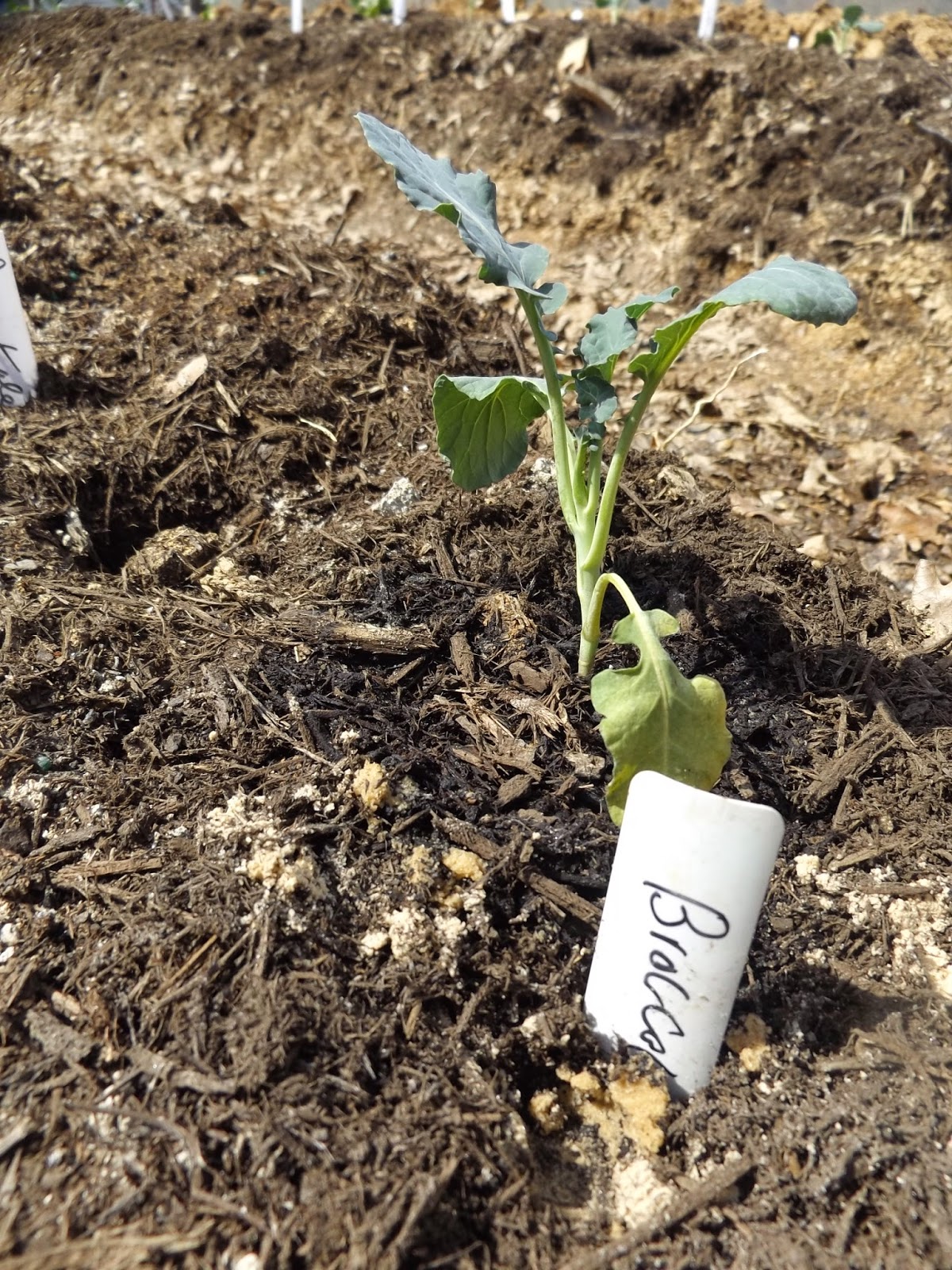
As you can tell, I have used many different materials cover small, young plants. Although I imagine the Brussels sprouts and Broccoli to be quite hardy to these weather conditions, there are tender greens sprouting like lettuce, spinach, kale, which I want to ensure protection from snow and frost that may accumulate. And using the plastic and row covers will trap some heat.


recycled item to protect broccoli


I made sure to cover the flowers too, except the Daffodils and Scilla flowers--there are too many clusters around the house to cover. I did cover the Hyacinths and Tulips, one with an old plastic fish tank and the others with recycled refrigerator shelves.
 
tulips covered
 
Hyacinths covered
 
Today's cold weather was a contrast to the sunny, warm weather we had for the last two weeks. We had freezing winds bringing in snow, which came as quite of a surprise. Quickly I cut bottles to put over the starter plants, then James and I covered the four Hugelkultur mounds with transparent plastic and row covers to retain heat through the cold night. The forecast predicts temperatures to drop to 24 degrees F tonight and tomorrow night.
 
row covers on Hugelkultur mounds to protect young plants

Monday, March 23, 2015

March growing Spring garden tour (video)

I showed you the many Cabbage plants growing underneath the plastic bottles. From several days ago, nearly half of the Cabbage starters died. Many of them were weak and it was to be expected. To fill in the spots where Cabbage had died, I replanted Brussels Sprouts, Broccoli, and Cauliflower, and Lettuce starters.

The garden looks much more alive and well...

Hugel mounds growing mix of Lettuce, Brussels, broccoli, cauliflower starters & seeds
Onions growing with Cauliflower and Brussels


Brussels Sprouts


Broccoli plants


Cauliflower with onions
In small patches, Lettuce, Spinach, Kale, Collards, Radish, Turnip, and Kohlrabi were directly sown in the mulch layer of the Hugelkultur mounds. Of course I have heard tiny seeds will not sprout through mulch, which is why I made holes within the mulch to add fine garden soil. Each vegetable has 10-15 patches growing in between the starter plants. I planted these days about a week ago or less. In the following weeks or month, we expect to begin harvesting from the greens.


lettuce growing


"Georgia" Collards

buttercrunch variety

red leaf lettuce grown from bottom

kohlrabi


For a detailed view of the Spring garden, watch the video posted below:


Friday, March 20, 2015

"10 Incredible Plant Facts you didn't know" by Kevin Mathews

From EcoWatch: Transforming Green, Kevin Mathews writes on the "10 Incredible Plant Facts you didn't know":

"1. The earth has more than 80,000 species of edible plants.
If you’re ever in the mood to try something new, the good news is that there is certainly food you haven’t tasted yet still growing somewhere in the world. You’ll probably have some trouble finding it, however, because …
Photo courtesy of Shutterstock
2. 90 percent of the foods humans eat come from just 30 plants.
Out of tens of thousands of plants we could eat, mankind chooses to consume only about 30 of them. It’s crazy to contemplate how limited our diets are compared to all of the different foods we could be eating. If you think the selection of which plants we eat has anything to do with their nutritional benefits, however, you’d be wrong …
3. Nutrition doesn’t factor into the crops we do mass produce.
The world’s largest farmers have pursued certain crops because they can grow a lot of them more quickly, easily and inexpensively to turn a better profit. As a result, most of the most healthful plants stay off of our dinner plates because they aren’t available at grocery stores. Still, sustenance isn’t the only thing humans rely on plants for …
4. 70,000 plant species are utilized for medicine.
As it turns out, humans are more diversified in the plants we use for medicine. Although a large portion of that figure applies to traditional medicine, modern medicine is not excepted from plant help. Half of the drugs prescribed in the U.S. have plant origins, many coming out of the rainforest, yet …
5. Only one percent of rainforest plants have been studied for medicinal potential.
Given how valuable plants can be medicinally, the rainforest houses a host of possible cures for ailments new and old. This untapped resource could still hold the key to medical breakthroughs. Of course, a lot of this potential could be lost considering …
Photo courtesy of Shutterstock
6. 80 percent of the Earth’s original forests have been cleared or destroyed.
The same forests that dominated the land 8,000 years ago are all but gone. Approximately four-fifths of the forests are gone thanks to human intervention—just think of how many plant species may have been lost in that process. If you thought protections were in place, actually …
7. Just 10 percent of the world’s plant-rich areas are protected.
Of the most biodiverse areas on the planet, only 10 percent are officially “protected” to ensure the survival of a multitude of species—plant and animal alike. Worse still, many of the supposedly protected areas are done so nominally only, leaving plants threatened by external factors they should be safeguarded from. This is especially problematic because …
8. More than half of plant species are native to just one country.
Chances are, a plant you find in one part of the world is not currently growing anywhere else. As plant habitat is ruined, there’s little point in hoping that the killed plants could be found and harvested somewhere else in the future. For this reason …
9. 68 percent of plants are in danger of going extinct.
While scientists have only examined a fraction of the existing known plant species, of those that have been studied, 68 percent face extinction in the not too distant future. Since plants can’t just up and move as their habitat is being destroyed, they are even more vulnerable than endangered animals. It’s happening quickly, too, since …
10. Plant species are going extinct—about 5,000 times faster than they should.
Some will argue that species would go extinct even without human interference. While that’s certainly true, it’s the rate that plants are dying off that raises alarm. Thanks to climate change, deforestation and other human-influence factors, experts believe that species are going extinct somewhere between 1,000 and 10,000 times faster than they would naturally".

Monday, March 16, 2015

What to grow in March in Zone 6 & Making raised beds

For the last couple of days, Kentucky was in a flood warning due to the amount of rain we were receiving; and eventually I managed to transplant cabbage, onions, and garlic bulbs, since we got a break from the rain. James and I were able to plant Cabbage starts, red onion bulbs, some shallots and garlic yesterday. We planted garlic and onion around the Cabbage plants to deter snails, caterpillars, and other things. Although I have heard weak plants put off stress hormones that attract destructive bugs, I have found that even the healthiest Cabbage and broccoli plants are vulnerable to many insects-- even rabbits!

Because March and April will predictably stay cold at night, I am using cloches to protect plants during the night. As you can see from the photos, I am using plastic water bottles which. I cut the bottoms off the bottle to place over top of each Cabbage plant. The cap is left off the bottle to allow the plant to breath. Without thinking, I was cutting the tops off the bottles then realized it was more efficient the other way. There are many ways to protect plants using recycled materials, which you can see here: Cloches plant protection (early planting & extend growing season).

Cabbage starters protected by plastic bottles

Yesterday reach 74 degrees, with partly cloudy skies--which was perfect conditions for transplanting starters. Of course I had another tray of cabbage starts to transplant. That particular tray of Cabbage starts are some of the weak plants which I am growing separately from the healthy Cabbage. The weak plants are being transplanted to the compost bed. I covered these plants with plastic bottles as well.

weak Cabbage starters transplanted in compost bed

In the Hugelkultur mounds, we have planted up to 40 healthy Cabbage plants and over 100 red onion plants/bulbs. Yesterday I directly planted Buttercrunch Lettuce, two types of kale, spinach, Collards, and kohlrabi within the cabbage and onion plants in the Hugel mounds.
I did not directly sow seeds within the mulch because the tiny seeds may not grow through the big pieces of wood chips. Instead, I made medium-sized holes throughout the mulch to fill with garden soil. The fine, loose garden soil are better growing conditions for tiny seeds.
If the weather permits, I expect to present a flourishing variety of greens and root vegetables within a month.

We recently purchased 9 Brussel Sprouts plants, 9 Broccoli plants, and 9 Cauliflower plants which will be planted within the Hugel mounds.

4 Hugel beds growing Cabbage, Lettuce, kale, spinach, onions, collards, radish & kohlrabi
Today I directly planted 80+ Lincoln variety Green Peas. Because I have onions growing throughout the Hugel mounds, I am growing Peas in a different location since Peas and Onions are bad companion plants. Off to the side in the triangle garden, I planted Peas around the fence. My method was making a small circular ditch around the fence, then adding garden soil to the ditch for directly sowing the peas.

Peas planted around fence

I was also able to plant Maiden Pinks and Delphinium flower seeds. I planted the flower seeds in the raised bed (in front of the Hugel mounds). This raised bed is dedicated to some short flowers, herbs, and other vegetables with some tall flowers. The raised bed was formed within a couple of hours a week ago, by laying out cardboard, then dirt and mulch on top. I added logs to outline the raised bed/contain the soil and mulch.

flower seeds planted in raised bed
It was another productive gardening day for me. I planted Peas, flower seeds, watered the garden, then assembled another raised bed. The raised bed seen in the picture above is situated across from the bed seen below. It was also formed by laying out cardboard, small sticks and leaf litter with dirt layered on top. Here I will grow Perennial herbs such as Thyme, sage, mint, and catnip in the hopes that they spread their seed in the field next to the house. 

raised bed for Perennial herbs
The Forecast is giving another chance of rain for Friday, so I have extra days to assemble two additional raised beds. One raised bed I'm working on lays slanted on a bank, situated beside the Paw paw trees. This bed will be growing Goji berries. The additional raised bed (I have not started yet) will be placed underneath an Apple tree where I will grow a variety of other herbs and flowers.

Wednesday, March 11, 2015

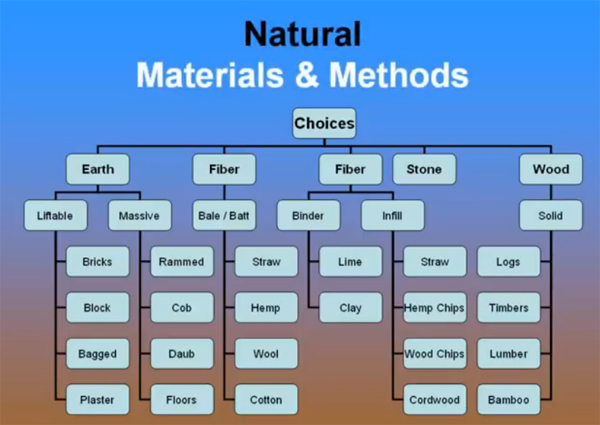
Types of Natural Materials & Methods for building Free/cheap HOMES

Natural building blog
The one material I disagree with using is the Wool. The Wool industry is cruel, and instead I would use denim as insulation. Along with the denim, natural home builders use aluminum foil as a reflector for light to generate heat.
The lumber industry is another cruel industry that rapes forests, so I'm not comfortable with having someone kill a living tree for me. Instead I would build a small scale home that requires no logs. If wood is mandatory I will find dead and dried logs from the woods. Unlike trees, bamboo and hemp grow quickly to be utilized for mass production. Bamboo could be used for framing, doors, and flooring.
I highly recommend using all natural materials like mud, straw, and sand for the majority of your home (walls & flooring). When you're making your cob and stacking the cob to the walls, you want to save as much material as possible. Then using other materials like recycled glass bottles allows you to use less of your materials. Use recycled materials you have on hand such as glass bottles, tires, rebar, and more.
By reducing the amount of trash we produce, and reusing the trash that already exists will allow us to clean up our environment.

Friday, February 27, 2015

Ways to Clean Trash/waste landfills

It's so easy to throw away trash and have it hauled off every week to be taken to a dump. I imagine a festering mountain of trash that could be transformed into a green mountainous landscape, like the Israel Hiriya garbage dump that was once "Shit Mountain" with 25 million tons of trash.  After the government closed the landfill, the dump was contained within the slopes and walls of the mountain stabilized and reinforced "using salvaged concrete debris from construction projects. Then the landfill was capped and covered, which allows Ayalon Biogas to collect methane produced by the still rotting garbage, which is used to power a textile factory" according to Treehugger. Six years later in 2004,  landscape architect Peter Latz designed a way to rehabilitate the area, while avoiding to flatten the mountain. The west tip of the mountain features a pergola and scenic vista.
Hiriya landfill turned into a park
The mountain represents a vision of the future, using Human's ability to transform our mistakes into solutions that will enhance symbiotic relationships between the land, humans, and other beings.
Nine other landfills were turned into Nature Preserves, such as Pulau Semakau, Tifft, Buffalo, Mount Trashmore, Virginia Beach, Bukit Tagar, Malaysia, Millennium Park, Massachusetts, Chambers Gully, Australia, Sai Tso Wan, Hong Kong,
Freshkills Park, New York, and Cesar Chavez Park, Berkeley.

The propagation of mushrooms all across waste sites and disaster zones have been known to clean oil spills and nuclear meltdowns.  Eric Rasmussen, a former Defense Department scientist and disaster expert, is collaborating with Paul Stamets to decontaminate the zone around Japan’s Fukushima nuclear reactor with mushrooms. Although methods for cleaning disaster and waste zones may take decade, Paul Stamets suggests several precautions and steps to cleaning the site, for example:
"1. Evacuate the region around the reactors.
2. Establish a high-level, diversified remediation team including foresters, mycologists, nuclear and radiation experts, government officials, and citizens.
3. Establish a fenced off Nuclear Forest Recovery Zone.
4. Chip the wood debris from the destroyed buildings and trees and spread throughout areas suffering from high levels of radioactive contamination.
5. Mulch the landscape with the chipped wood debris to a minimum depth of 12-24 inches.
6. Plant native deciduous and conifer trees, along with hyper-accumulating mycorrhizal mushrooms, particularly Gomphidius glutinosus, Craterellus tubaeformis, and Laccaria amethystina (all native to pines). G. glutinosus has been reported to absorb – via the mycelium – and concentrate radioactive Cesium 137 more than 10,000-fold over ambient background levels. Many other mycorrhizal mushroom species also hyper-accumulate.
7. Wait until mushrooms form and then harvest them under Radioactive HAZMAT protocols.
8. Continuously remove the mushrooms, which have now concentrated the radioactivity, particularly Cesium 137, to an incinerator. Burning the mushroom will result in radioactive ash. This ash can be further refined and the resulting concentrates vitrified (placed into glass) or stored using other state-of-the-art storage technologies.
By sampling other mushroom-forming fungi for their selective ability to hyper-accumulate radioactivity, we can learn a great deal while helping the ecosystem recover. Not only will some mushroom species hyper-accumulate radioactive compounds, but research has also shown that some mycorrhizal fungi bind and sequester radioactive elements so they remain immobilized for extended periods of time. Surprisingly, we learned from the Chernobyl disaster that many species of melanin-producing fungi have their growth stimulated by radiation" (Permaculture: Practical solutions for self-reliance).

I have mentioned many times how to use Trash, waste, and other recyclable materials in the garden and when constructing the home, which you can see in some of my posts: Construct a Greenhouse using Free supplies, Recycled Cardboard box garden, Recycled (car/truck) Tire Gardens, and Cloches plant protection (early planting & extend growing season). I did mention that using car/truck tires for growing vegetables is not recommended, but many gardeners do this. In other words, if you don't feel comfortable using plastic, pallets, tires, or cardboard in your garden, don't use them.

Specifically on this topic, I wanted to present how I have been handling Trash/waste that I cannot use in the garden or home. There are simply materials that are dangerously laden with chemicals that you cannot use for the vegetable garden. For example, in the last couple of years, James and I have remodeled my mother's home; and in doing so, we have accumulated trash such as drywall, bits of wood, and roof materials we had to pile up in the yard. Instead of taking these things to a landfill (which you have to pay to discard), I spread the waste out to be covered with sticks, then straw, dirt, and mulch. At first I will use the bed for growing non edible plants.
You can see from the photo below the drywall is scattered level, then I have layered twigs/sticks on top.  After that I will add layers of straw or grass, then dirt from around the yard, then add mulch to plant flowers. This took about an hour or two to assemble and gather the materials myself. I think if I have another couple of hours I will be able to finish the bed for planting.
Considering this spot is on the West side of the home, it doesn't get much sun, so I will plant flowers/plants that do not require much sunlight like Hostas and Ferns. Actually I have a post on flowers that shade tolerant: List of Shade & Cold tolerant plants (vegetables, herbs, flowers).


"As of 2010, Total MSW generation was 250 million tons. Organic materials continue to be the largest component of MSW. Paper and paperboard account for 29% and yard trimmings and food scraps account for another 27%; plastics 12%; metals 9%, rubber, leather and textiles 8%; wood is approximately 6.4% and glass 5%. Other miscellaneous wastes make up approximately 3.4%" (EPA).
With many of the landfills that exist and radioactive places of the world, we can cover with wood material and grow mushrooms that will clean and absorb radioactivity. You could cover dumps in dirt and mulch then grow trees on top. Of course they do not have to edible fruit or nut trees, but you could grow any types of Trees, and actually grow only fruit/nut bearing trees for the wildlife to create an environment promoting life.

The reason I advocate for using recycled materials is to keep trash OUT of the landfills, however I am not advocating for MORE trash like plastics, cardboard, paper, and glass to be manufactured at all! In fact, I see the use in technology of computers and books, but we do not need to create so much waste per person.
Any foods made in a factory, any clothes, and other useless junk do not contribute to Human evolution and potential. With all of the clothes that already exist, we can cloth every person. There is no need to make anymore clothes when we can all shop at goodwill; with all the food produced in the world, we can feed every person. The reason not every child is fed because of consequential actions of the rich vs poor and livestock industry that grow grains for animals. With all the plates, cups, jars, and silly trinkets that exist we can furnish every home.
Where necessity is concerned, we don't need frying pans, blenders, food processors, bowls, plates, and cups to eat when Fruit harvested from trees are perfectly designed for immediate satisfaction. It's no coincidence that all other animals eat raw-- that's how we were designed to eat.
We can grow our own food by propagating from fruit and nut trees; make our own homes out of clay dirt, straw, and sand for free (see here), we can make our own pottery by firing clay soil with sand. What we produce such as computers and technologies can be made in factories that harness Sun energy for power, and re-route pipes that release carbon emissions into the ground which the plants will use and clean the air (known as Carbon sequestration).


carbon sequestration
These solutions are already implemented, however this generation is in a transition period of using COAL, Petroleum oil, burning fossil fuels, creating trash, polluting air and water, eating animals. I see a small light at the end of the tunnel for centuries to come...

Tuesday, February 24, 2015

EARLY blooming Spring Flowers (February-April)

Hyacinths growing in the snow
In my area, the Daffodils pop up as early as January and February. Of course they do not bloom until early March.
I live in Northern Kentucky, where the Dogwoods and Locusts trees bloom through March and April. The Hyacinths are in full bloom, as well.
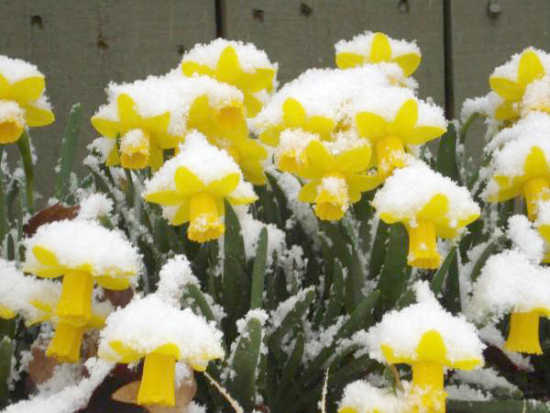
Sometimes they bloom so early I feel the need to mulch and cover early blooming flowers with cloches. For my post on Cloches and making your own plant protection, read here: Cloches plant protection (early planting & extend growing season). I remember one year when the Daffodils were growing through the a Winter storm, and I made sure to protect them with plastic bottles and other plastic containers to keep them warm and protected from the snow.


Daffodils withstanding snow and cold
 It's nice to see flowers pushing through the snow and begging for Spring weather.  Growing early blooming flowers sets the pretext for a beautiful summer. Design your Perennial garden to bloom from Early Spring and transition into different times of the year.

 
Below is a list of the following Flowers which bloom early in the Spring.


Ajuga
Lenten Rose
Azalea
Lungwort
Bleeding heart
Lupine
Bloodroot
Mahonia
Camellia
Marsh Marigold
Carnations
Pasque

Dogwood
 
 
Primrose 
Cowslips
Scilla
Creeping Phlox
 
Snowdrops
 
Crested Iris
Spicebush
Crocus
 
 
Spiraea
 
Daffodils
Star Magnolia
Eranthis
Sweet violet
Flowering Quince
Tulip
Forsythia


Vernal Witch hazel
 
Fritillaria
Viburnum
Giant Snowflake
Vinca
Grecian Windflower
Virginia Bluebells
Heartleaf Brunnera
Winter Aconite
Hyacinths
 
Japanese Pussy Willow


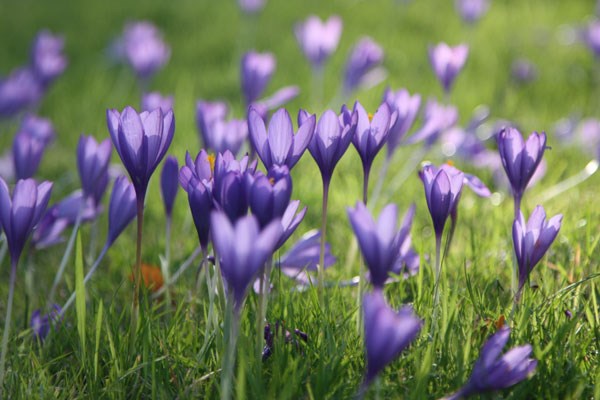
Feel free to look through my Floral photographs of many of the Early blooming flowers, here: Collection of Floral Photography 2014. One of the photographs from last year's collection was of the Hyacinths that grew at the end of March and early April, seen below.

Hyacinths from the yard