Friday, February 14, 2014

How to build a raised bed for gardening (& No-till methods)


Gardening is usually maintained on solid ground, yet as we become a developed nation with little room to dedicate to gardening, we find innovative ways to grow food in smaller spaces. Smaller spaces means utilizing containers in which you can grow food.
Raised beds and container gardens are best for people with limited space, but there are many other benefits. Raised beds and container gardens are low maintenance, for example easier to water, pull up weeds, and relocate bugs. Raised beds are also easy to construct in comparison to ground gardens because there is no shoveling, tilling, or hoeing. Raised beds and containers essentially do not damage the soil or any rooting systems in the Earth. Raised beds and containers also repel many bugs and other animals from intruding and eating the vegetables unlike a normal large garden. And best of all, raised beds and container gardens can always be constructed for free with little time.


Many of my posts on gardening feature ways to build raised beds or use containers to grow food. Considering it is the middle of February, it is the best time to plan your garden layout. You can start tomato plants indoors as early as now and you can work up a spot in your garden with a tiller to plant greens and other cold weather crops as early as the middle of March. It is important to work early and think ahead when growing food.
Here are some posts that discuss topics on making your own compost and building raised beds using free materials:
Raised beds are usually constructed out of recycled or reclaimed materials or all natural materials. By constructing your own raised beds now will give you time to find the materials to fill them (dirt, compost, mulch, and other organic matter). As you can see in the picture, the best way to begin a raised bed or container garden is to find a location, then a container (5 gallon bucket, log bed, brick bed, rock bed, etc), then fill your container with the materials you see in the picture below.
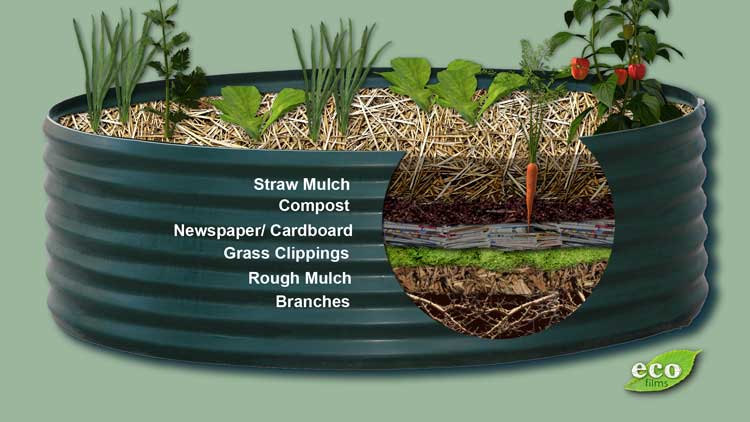
Raised beds are like containers which hold your growing medium. The growing medium is just as important as the utility of the container. The growing medium must be made out of organic matter such as mulch, compost, twigs, and dirt (while compost is made up of other decomposed organic matter like food scraps and leaves).
Last Fall I had a very successful crop of beautiful and tasty lettuce that came from a container full of my own compost (seen in the picture to the left). This lettuce produced as long as three months. Make sure your container has holes in the bottom to ensure drainage of water. Then add twigs, bark, newspaper, or cardboard, then add your grass clippings, then compost, then mulch.

If you are not using a container like a 5 gallon bucket or drum, or other reclaimed material, a raised bed made out of bricks, logs, or rocks is another free, no-hassle, low maintenance way to grow food.
 Raised beds are simply beds of dirt held in by other materials to form a structure. Raised beds can be made through many creative designs. For example in the pictures below I have listed pictures of raised beds made out of all natural, free materials:
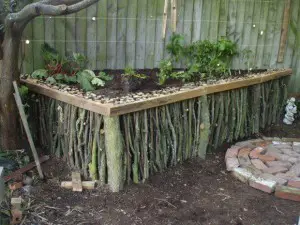
Sticks are vertically aligned and layered to hold dirt in place.


My partner built a raised bed from free pallets


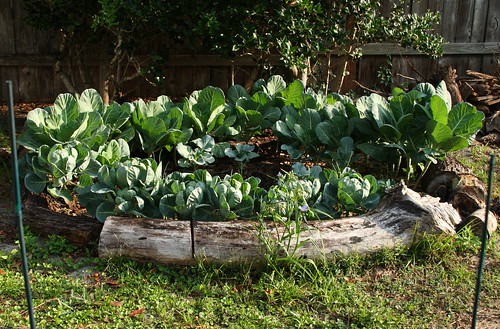
Found logs hold in a garden of cabbage

Another beautiful thing about raised beds is that you do not necessarily need a structure like bricks and rocks to hold the dirt and your veggies. In fact, you can simply find a location suitable to your needs, then add layers of mulch then dirt on top of the ground. With this method, no shoveling or tilling is required. I believe, however, the best way to ensure the dirt does not drift away when it rains, at some point you need to create a structure around the dirt. Many examples of this are straw bale gardens, like in the pictures below.
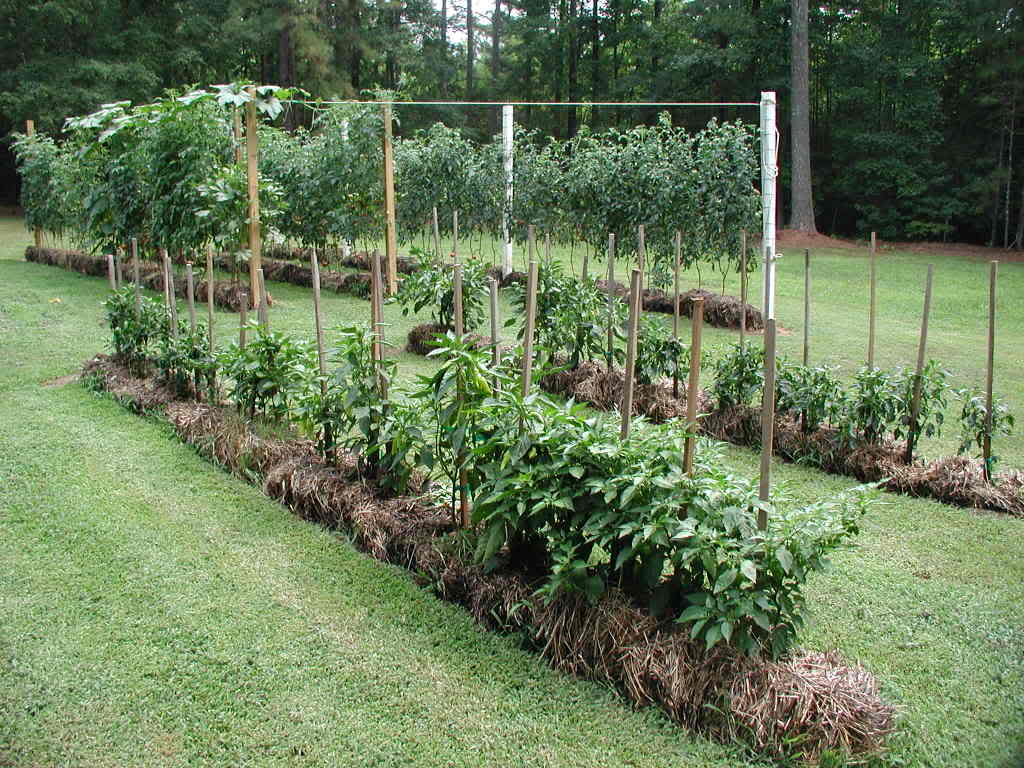
Notice the straw and dirt are piled up above ground.
You can grow plants that are just as big on straw bales as you
can in the ground.

Minimal layering of dirt is needed to grow food on straw bales.

 Successful gardening is 80% preparation (or perhaps determination) and 20% weather. Start planning your gardening layout, then retrieve materials you need, then begin on prepping your garden. There are many chores that must be done before you begin gardening in the Spring, for example I have outlined what activities in the following posts: "Fall & Winter Garden Maintenance", "Garden prep (what I'm doing to prepare for spring gardening", "My Vegan Garden Calendar for 2013 (& planting days for you" in this post I detail a day-to-day gardening activity. And in the post "What vegetables to grow during the summer (May, June, & July)" I picture the harvests of my fruits and vegetables that I grew during the Spring and Summer. I also picture what I grew and harvested during the Fall in this post "What to grow during August-October".
In future posts I will be detailing what I'm doing in my garden. As you may or may not know, I am in another state, so it may take some time before I get back to Kentucky to begin gardening. Once I make it back to KY, I will chronicle what I'm doing to prepare for starting seeds indoors, and other miscellaneous activities. Stay tuned.

Monday, February 10, 2014

Semi-Permanent Debris Shelters (Minimal Living or living in the woods)

I've become obsessed with videos on constructing debris shelters, survival shelters, and creative ways to build out of readily materials within a short amount of time.

There are many types of emergency survival shelters such as Wikiups, wigwams, Tarp shelters, igloos, underground, and the list goes on. The most basic constructs are shelters formed with dead wood, then layered with an insulation such as twigs, sticks, leaves, mud, tree bark and so on.


A debris shelter allows you to form a fireplace and chimney attached.


 Below I will list some of the videos I think will help you build these shelters in a survival situation. These shelters can also be added to on a larger scale for semi-permanent to permanent dwellings.

Shelters like these are easier on our environment, they allow us to reconsider what is important in life: reading, breathing, meditating, walking. With this way of living, we let go of material, frivolous items, and spend more time in nature.

The list below consists of videos on the construction of debris huts, underground dwellings, and survival shelters. You can type in any search engine these keywords to look at more interesting pictures of these shelters. They key to learning how to build these shelters is by experience. Go outside to the nearest woods or your backyard and build you one of these shelters out of the readily available dead wood (and because it's winter, there will be plenty of leaves to use to act as insulation for your hut).

The video above "How To Build a Semi - Permanent Shelter (part 1)" which teaches you to build a debris shelter with a fireplace/chimney included, remember to watch part 2

In this video, Mike Douglas of Maine Primitive Skills School teaches you a step by step on how to pick a spot, what to use, and other information on debris shelters. Remember to watch part 2.

Here is a small tutorial on how to make a lean to natural shelter out of spruce limbs. The only tools are an axe and some twine. I do not advocate cutting down any live trees, only use dead wood.

Friday, January 10, 2014

Extreme environmentalism


Henry D Thoreau from Walden says, "I went to the woods because I wished to live deliberately, to front only the essential facts of life.." I live my life by these respects. I will work hard for my own to build shelter, and grow my own food-- other than these basic essentials, why would I need anything else?
I can better spend my time in the woods, exploring, and living for free.
Naturalism similarly suggests conserving energy, recycling, reducing waste, and other clean practices. Yet animals do not recycle or commit to clean practices because that's simply their nature. People have invented microwaves to heat food and television for entertainment.
"Men have become the tools of their tools" is an accurate portrayal on the disillusionment within our society.
What are some of the practices of wild animals? Animals eat a raw diet (whether they're herbivore or carnivore). Animals build their own shelter out of readily materials-- using their own strength (without machinery); own no clothing or use hygiene products; and Obviously the list goes on.

Minimalism is included in the practices of naturalism and environmentalism. Minimalism suggests letting go of unnecessary objects/possessions in your life. 'Letting go' has been a mantra in Buddhism and many other philosophies. Herman Hesse writes in Siddhartha "Property, possessions and riches...had become  chain and a burden".
Once you have become free of many of your possessions, or all, you feel free to move-- as if you've lifted the weight of your belongings off of your shoulders.
Focusing on our most basic needs and living independently from bills and corporations, will force you to grow your own food; build your house out of mud/straw/sand/rocks; filter water you have collected to drink; eat raw herbivore diet; wash your clothes minimally and do not own much clothing...or much of anything.
The  idea is to conserve finite resources and minimalize on space. Animals are usually nomadic creatures, and do not carry 'things' with them. Although the couple in the picture below are practicing minimalism, they are not practicing all natural living, which is fine if they want to live in a city with air pollution and commercialism.


this is NOT an example of natural minimalism
Another topic I will bring up (at a later date) is my refusal to drive vehicles. Not only are vehicles unsafe, but they're environmentally unstable unless we can ALL design our own water vehicles, or make our own moonshine for fuel. Then again, water may be a scarce source in the future.
I prefer to walk where I need to go, usually walking 1-4 miles a day. If I'm going to a friend's house, they'll give me a lift for courtesy.
Going back to water shortage, my grandparents and my partner and I shower minimally, once every two weeks, or use wash rags for face and privates. Using these practices will help me in the future when I will be living outside. I have many other ways I conserve water in this post, "How to Save/Recycle/Conserve Water".
Generally, if you live in a city you can also recycle glass and plastic for a little bit of cash.
My family drinks soda, so I have them save the cans to recycle (and I collect some along the road as I walk)-- I do this to make a couple of dollars too.
My grandparents even practice extreme environmentalism; recycling all plastics, cans, containers, and cardboard/paper. When I mention recycling, I do mean you should recycle or reuse objects you come to possess, but I also mean limiting your purchases. If buying food from a store, buy food in bulk (which comes in boxes), or use cloth bags. Purchase less stuff and eat food that can be composted.

Furthermore, do your part to clean up your environment, not just inside your home. Humans have the advantage because we are evolved animals who must take the responsibility to balance the use of technology with nature and wildlife.


pic from "Circle of Iron" with David Carradine
We can choose to use solar panels for electricity, and learn many homesteading techniques to live freely. We can grow our own food. We can build our own home. We can walk our own path.

Wednesday, January 8, 2014

Habits of really healthy people

Animals spend most of their life searching for food, sleeping and building shelter. I would assume that if we encouraged ourselves to revert to our wild selves, we would forage for fruits and nuts, greens and mushrooms all day. We would also eat raw, like the animals. We would drink lots of water, sleep on the floor, live in a natural habitat, and breathing much more oxygen; in other words, you would be consistently exercising and eating a clean diet while living holistically.

Even a healthy body runs the risk of battling a disease or illness due to air and water contamination, pollution, genetically modified foods (GMOs), etc.
However preventative measures should be taken to strengthen your immune system and keep you able-bodied (youthful). Diet and exercise play dominate roles in bettering your life and getting rid of ailments. A Small but important factor to your health is mentality (continuing to educate the mind and keep it sharp).

Considering the plethora of food and commercialism, it is not coincidental that heart disease and stroke is the first and third leading cause of death among men and women in the US (according to the CDC).
We can blame ourselves, but lets not forget that food has become subsidized in order for corporations to sell unhealthy products at a lost cost (abusing low income families).

Wealthy people eat small portions of meals through the mail (from corporations like Jenny Craig or Nutrisystem). The mindset behind these programs and products are to limit your calorie intake in order to still eat unhealthy foods you crave. A starved individual will eat ANYTHING-- which is why I suggest eating healthy food in large quantities (fruits, vegetables, salads, nuts).

Habits of really healthy people are the ones that fulfill their needs and enable us to perform our best, such as:

-Eat a diet rich of fruits and veggies (eat plenty until satiated)
-Drink water in place of alcohol, soda, and coffee
-Exercise 30 minutes everyday
-Get 30 minutes of sunshine in summer and more during winter
-Sleep 7-8 hours a day or more (as much as you need)

I understand to most people this may be difficult to achieve, or even this sounds a little Obsessive Compulsive-- well you're sort-of-right! I have been Obsessive Compulsive all of my life and this lifestyle can be difficult in social situations.
I digress, when we fulfill our goals and feel our best, the healthy people get their emotional and physical needs met.
This lifestyle is for long term health and long term results. Sometimes cancer can leave the body within a couple of months by switching to a vegan diet, and sometimes it takes 4 years to lose 40 pounds.

One of my habits is eating mono meals (one food in a large quantity). My family finds it amusing to watch me eat 7 individual bananas for breakfast or plain lettuce with 6 individual potatoes for dinner.
I have repeatedly said throughout this blog: I eat large quantities of food in abundance of carbohydrates and sugars, but my focus is on limiting fat and protein intake. Yes, I said I emphasize my diet on sugars and carbs-- most "nutritionist", 'health' products, and doctors would find this inaccurate, while other specialists promote this diet and lifestyle.

Calorie restriction and limiting carbohydrates and sugars are not healthy practices. In fact, I suggest the opposite: obtain 2500-3000 calories from bananas and other fruits through the day for energy, and salads for relaxing at night. If you are more interested in the starch-based diet, then eat plenty of potatoes, rice, and some beans (while eating fruit during the day or snacks). I suggest eating lots of potatoes and rice if you cannot eat many bananas, like me. If you are not moving your body or using calories, then you do not need as many calories. But for me, I exercise everyday so I eat a lot more than people.
My message about health is consistent, for further reading material on health, click the links below:


Vegan doctors such as Neal Barnard, John McDougall, Doug Graham (and many more), agree that an individual should intake 80% of your food from carbohydrates and 20% of their calories coming from fat and protein. Diets rich in protein and fat harm the body, clogging its arteries and creating acidity in the blood. A body in this state is susceptible disease and cancer.

What foods have fat and protein and are acid-forming?: Meat, dairy, and eggs (animal derived foods). In other words, your diet should be one rich in fruits and vegetables, and plenty of water. Please read my post on why Cow's milk is harmful to the body, here: "Is Organic & Raw Cow's milk better than conventional milk?".

Vegan diets are the most optimal for our organism because we are similar in physiology of apes. Like apes, we should spend some time everyday in nature, playing, running, climbing, throwing, and obtaining sunshine. Small, light exercise everyday helps keep the body fit and young.


Animals spend most of their life searching for food, sleeping and building shelter. I would assume that if we encouraged ourselves to revert to our wild selves, we would forage for fruits and nuts, greens and mushrooms all day. We would also eat raw, like the animals. We would drink lots of water, sleep on the floor, live in a natural habitat, and breathing much more oxygen; in other words, you would be consistently exercising and eating a clean diet while living holistically.

Habits of healthy people are lifestyles our monkey ancestors practice: eat fruit, play, drink lots of water, and sleep (early nights). Use these four practices to obtain a healthier you; most importantly to get rid and prevent dis-ease.

When discussing habits of healthy people, there are lifestyle choices that should be practiced and should not be practiced. In other words, there are things healthy people would not do in order to maintain their health, for example smoking cigarettes.
As we know, Healthy people are known to get plenty of sunshine, drink lots of water in place of all drinks, eat a diet rich in fruits and veggies, get plenty of sleep and exercise. But, unhealthy are known to:
-Smoke cigarettes or other drugs
-Drink alcohol, soda, energy drinks, soft drinks
-Use drugs (nicotine, caffeine, pain killers, cocaine, meth, etc)
-Eat a diet rich in fat (meat, dairy, cheese, eggs, oils)
-Eat an acidic diet with vinegar, coffee, soda, and animal foods
-Stagnant, or lazy (never exercises, walks or runs outside)
-Apathetic or unhappiness which leads to depression
-Get little sleep (or stay up late after dark)
-Stressors (family, job, kids, money <--roots of evil)

There are many ways to be unhealthy, just as there are many habits that allow you to maintain your health (like drinking fruit juices instead of coffee, or reading or exercising instead of watching TV).

Saturday, December 21, 2013

Is Organic & Raw Cow's milk better than conventional milk?


I was looking through OfftheGridNews.com, and of course they have many articles on gardening, so I commented on many articles to promote this blog. When I was reading the article on Organic v. Conventional cows milk, I attempted to leave three comments disagreeing on the consumption of any milk.
Unlike my gardening comments that were published at the end of the articles, this particular article would not publish my comments. I'm SURE this is not because of the disagreement, rather the article was not responding to any comments at all. All the same, it created a little tension in me which prompted me to write about this topic. Here are my thoughts:

First, please read my post on the "Protein Myth" here, which will contain excerpts from "The China Study" that contend high protein diets create higher risk of cancers and disease.

There's a reason why cows make milk (for their babies) because they were pregnant. Animals (humans) quit producing milk when their babies do not need it anymore. So, if our mothers quit producing milk, then you do not need to drink Mother's milk (cows included) anymore.

Actually the reason babies drink milk is in order to grow much larger, and triple their size. If you continue to consume milk or animal flesh/secretions, you will become obese, or become susceptible to disease and cancer due to their high fat and high protein content. 

An ironic fact about consuming cow's milk: wouldn't you assume you would get the necessary amount of calcium, protein, and vitamin D from eating a similar diet of cows, elephants, giraffes, oxes, etc?

Animal foods contain much higher levels of acid in the body, which alters the pH of your blood. When there is acidity in the body, calcium is pulled from the bones in order to restore neutral or low pH of the blood. Adding to this, Cows milk (organic, raw or not) still contains millions of pus cells.

With this in mind, it is funny how media advertisements push dairy and meat products. It's almost as if they want you to eat a diet that will cause disease.
I will also mention that it is not only animal flesh and their secretions that harm the body, but also protein rich foods like beans, nuts, seeds, and grains (rice, bread, oats, quinoa) as well as acid foods like vinegar, tea, coffee, and soda-- all of which are 'vegan' foods.   
It is a myth that we do not get 'enough' protein, due to the fact that no one has died of a protein deficiency (unless if they're anorexic). Also, all essential amino acids are found in BANANAS alone. It is also a myth that protein is only found in animal products. I calculated a typical day for me, and I exceed the required grams of protein a day, just by consuming raw fruits and greens. Sometimes (every other day or twice a week) I have rice, potatoes, beans or nuts which contain higher levels of protein-- but I obviously do not need those foods if I eat raw fruits and greens. 

But lets put health aside for a second, and consider the feelings of other animals. You are an animal; so what makes you, dogs or cats any less superior than killing pigs, chickens, cows and the like for food? We live and die all the same. We and other animals cry and scream when being tortured the same. Why do YOU the consumer and farmers get to decide what dies? 
Mother nature does a good job all on her own. 

Carl Sagan from the Cosmic Connection talks about the intelligence of whales and dolphins, saying "...if we can so easily rationalize the slaughter of others of our own species, how much more difficult will it be to have reverence for intelligent individuals of different species?"